
Five kettlebell exercises cover almost everything a general programme needs: the two-handed swing, the goblet squat, the Turkish get-up, the single-arm row and the suitcase carry. The swing comes first, with measured gluteal activity around three quarters of a maximum contraction. One bell, a few square metres and twenty minutes twice a week is enough to train all five.
Hinging, carrying and pressing under load are the movements that build tolerance to everyday strain, which is the argument running through PhysioHub's guide to injury prevention exercises.
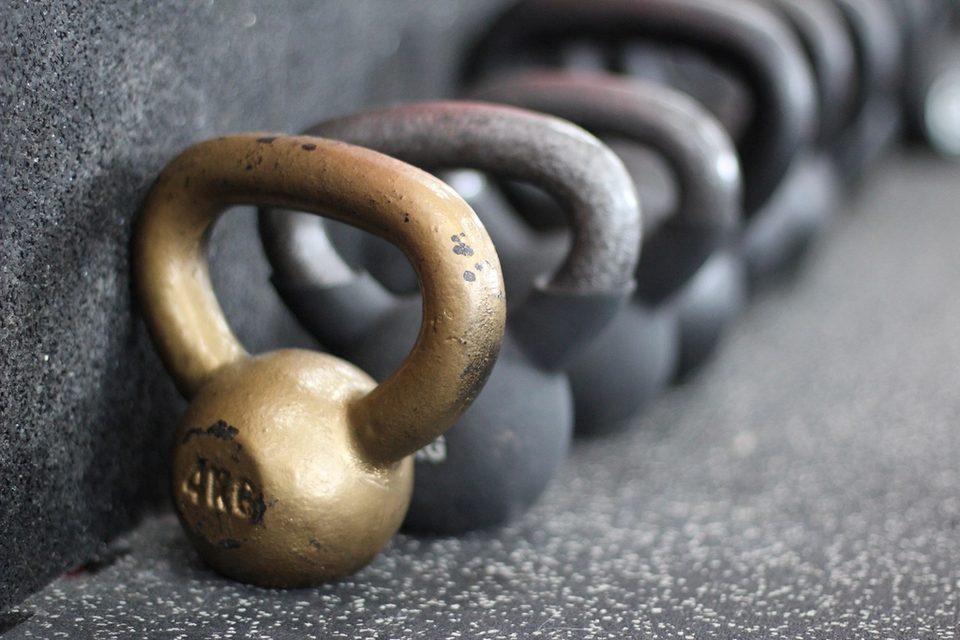
One kettlebell covers all five. They are ranked on what each returns for the time it takes, how much of the body it trains, and how quickly someone can learn to do it safely.
| Exercise | Best for | What makes it stand out | Dose |
|---|---|---|---|
| 1. Two-handed swing | Hip power and conditioning | Very high measured gluteal activity from one bell | 5–8 × 10–20 |
| 2. Goblet squat | Learning to squat well | The front-loaded position teaches the position by itself | 3 × 8–12 |
| 3. Turkish get-up | Shoulder control and whole-body coordination | Trains the shoulder overhead through every position | 3–5 × 1–3 each side |
| 4. Single-arm row | Back strength, one side at a time | Balances the pressing and hinging in the rest of the list | 3 × 8–12 each side |
| 5. Suitcase carry | Trunk and grip | The most direct training there is for carrying things | 4 × 20–40 metres each side |
This is a documentary review of published biomechanics and training evidence rather than a laboratory test run by us. Around fifteen kettlebell exercises were considered, including the two-handed swing, one-handed swing, snatch, clean, clean and press, military press, goblet squat, front squat, Turkish get-up, windmill, single-arm row, high pull, halo, suitcase carry, farmer carry and bottoms-up carry.
Four criteria decided the order: measured muscle activity where it exists, how much of the body the exercise trains at once, how long it takes to learn well enough to load, and whether it can be progressed for months with a single bell.
The main source read was McGill and Marshall's 2012 study of kettlebell swings, snatches and bottoms-up carries in the Journal of Strength and Conditioning Research, which measured back and hip muscle activation and spine loading, alongside published training studies on kettlebell programmes and the NHS physical activity guidelines. Evidence checked in August 2026.
What could not be checked: the research base for kettlebells is much smaller than for barbell training, and most of it involves small numbers of participants. No trial has compared these five head to head over a training block, so the ranking reflects mechanics and teaching experience as much as measured data.
Learn the hinge before anything ballistic. The swing, the clean and the snatch are all the same hip movement performed faster. Someone who cannot hinge with a light bell will squat the swing instead, which is where the sore backs and shoulders come from.
Pick a bell for each job. Swings need a heavier bell than pressing does, because the hips drive them. Using one bell for everything means either swinging something too light or pressing something too heavy.
Include a carry. Carrying a load in one hand is the most transferable trunk exercise there is, it takes no skill to learn, and it is almost always the missing piece in a home programme.
Match complexity to your time. The get-up is the most valuable exercise on this list per repetition and the slowest to learn. If you have twenty minutes twice a week, swings, goblet squats and carries will take you further than a half-learned get-up.
What it is
A hip hinge performed fast, with both hands on the bell, driving it to roughly chest height and letting it fall back between the legs.
Who it suits
Almost everyone once the hinge is learned, and particularly anyone who wants strength and conditioning from the same exercise in a small space.
How to do it
Feet slightly wider than the hips, bell about a foot in front. Hinge at the hips, hike the bell back between the legs like a rugby pass, then snap the hips forward hard and let the bell float up. The arms stay relaxed and the bell stops around chest height. Squeeze the glutes at the top and let the bell fall back into the next repetition. Five to eight sets of 10 to 20.
What the evidence supports
McGill and Marshall's 2012 study in the Journal of Strength and Conditioning Research recorded peak gluteus maximus activation of 76 per cent of maximum voluntary contraction and gluteus medius of 70 per cent during two-handed swings with a 16 kilogram bell. They described the movement as a hip hinge pattern in which the glutes drive the bell, preceded by back extensor and abdominal activity that keeps the spine rigid and transfers hip drive to the bell.
Limits and cautions
Squatting the swing and lifting the bell with the arms are the two faults, and they usually appear together. Both are solved by hinging further back and using a heavier bell, which forces the hips to do the work. Anyone with current low back pain should learn the hinge unloaded first. The rapid activation and relaxation cycle is demanding, so start with fewer sets than feel necessary.
Time and effort
Twelve to fifteen minutes including rest. It is genuinely tiring, and the breathlessness arrives sooner than the muscle fatigue.
Why it made the list
It ranks first because no other exercise here trains hip power, the glutes and cardiovascular fitness at once with a single piece of equipment. It is also the exercise the rest of kettlebell training is built from.
What it is
A squat with the bell held at the chest in both hands, elbows tucked inside the knees.
Who it suits
Beginners learning to squat, anyone whose barbell squat depth is limited, and anyone training at home with one bell.
How to do it
Hold the bell by the horns at chest height, feet slightly wider than the hips with the toes turned out. Squat between the knees until the elbows pass inside them, keeping the chest up and the whole foot on the floor, then drive up. Three sets of 8 to 12. Pausing for a second at the bottom makes a light bell feel much heavier.
What the evidence supports
Holding a load at the chest shifts the centre of mass forward, which lets most people reach a deeper position with a more upright torso than they manage with a bar on the back. That makes it a useful teaching tool as much as a training exercise, and it means the lower back carries less of the load, which is covered further in our guide to proper form when squatting.
Limits and cautions
The load ceiling is low, because the limiting factor eventually becomes how heavy a bell you can hold at your chest rather than how much your legs can lift. Elbows drifting outside the knees usually means the bell is too heavy or the stance too narrow.
Time and effort
Six minutes. It is the most beginner-friendly exercise on this list.
Why it made the list
It is the fastest route to a decent squat pattern, and the position corrects most of the faults people bring to squatting without anyone needing to coach them.
What it is
A slow, staged movement from lying on the floor to standing and back down again, with a bell held overhead in one hand throughout.
Who it suits
Anyone who wants shoulder control alongside strength, anyone returning to overhead work after a shoulder problem, and anyone whose training is otherwise all straight lines.
How to do it
Lie on your back, bell pressed up in one hand, same-side knee bent. Roll onto the opposite forearm, then the hand, bridge the hips up, sweep the straight leg through to a half-kneeling position, stand, then reverse every step. The arm stays vertical throughout and the eyes stay on the bell until standing. Three to five sets of 1 to 3 each side, with a light bell.
What the evidence supports
The get-up trains the shoulder to stabilise a load overhead through a full sequence of body positions, which is the demand that most overhead pressing programmes miss. It is widely used in shoulder rehabilitation for that reason, and the loads involved are low enough that it stays available while heavier pressing does not. Our guide to rotator cuff rehabilitation covers where this fits in a return to overhead work.
Limits and cautions
It is the hardest exercise here to learn and the easiest to do badly. Learn it with a shoe balanced on the fist before adding a bell. Anyone with current shoulder pain overhead should hold off until that range is comfortable. Rushing the steps is what causes the wrist and shoulder complaints associated with it.
Time and effort
Ten minutes for a few repetitions each side. Every repetition takes 30 to 60 seconds, which is why the counts look so low.
Why it made the list
It is the only exercise here that trains the shoulder overhead in every position the body passes through, and it exposes side-to-side differences within one repetition.
What it is
A supported row with one hand on a bench or knee and the bell pulled from arm's length towards the hip.
Who it suits
Anyone whose programme is swing-heavy and pull-light, which is most people who train with one kettlebell.
How to do it
Hinge forward with one hand on a bench or resting on the front thigh, spine level. Let the bell hang, then pull it to the hip, allowing the shoulder blade to travel at the end, and lower until the arm is straight and the shoulder blade reaches forward. Three sets of 8 to 12 each side.
What the evidence supports
Rowing one arm at a time produces high latissimus dorsi activity with the trunk supported, and it balances the front-of-body demand created by swings, squats and presses. Training one limb at a time also brings side-to-side differences into the open, which a two-handed exercise hides. Our guide to lat exercises covers the ranking of pulling exercises in full.
Limits and cautions
Twisting the trunk to help the bell up is the usual fault and it turns a back exercise into a rotation exercise. The offset handle of a kettlebell makes wrist position matter more than with a dumbbell, so keep the forearm and the bell in a straight line.
Time and effort
Eight minutes for both sides.
Why it made the list
A kettlebell programme without a pull is a programme with a hole in it. This is the simplest way to fill it with the equipment already in the room.
What it is
Walking a set distance with a bell in one hand, keeping the trunk upright and level.
Who it suits
Everyone, and particularly anyone with a desk job, anyone who struggles with shopping and luggage, and anyone whose trunk work has stalled at planks.
How to do it
Pick the bell up with good technique, stand tall, and walk 20 to 40 metres without letting the trunk lean towards or away from the weight. Swap hands and repeat. Four rounds each side. If the shoulder on the loaded side is hiking up, the bell is too heavy.
What the evidence supports
Carrying a load on one side loads the trunk asymmetrically, so the muscles on the opposite side work continuously to stop the body folding sideways. McGill and Marshall included a bottoms-up carry in their 2012 kettlebell study for exactly this reason, and carries have since become a standard part of trunk and shoulder programmes because the demand is high and the skill requirement is almost nil.
Limits and cautions
Very few, which is part of the appeal. Grip usually fails first and that is a legitimate training effect. Anyone with current low back pain should start at a distance that feels almost too easy and build from there.
Time and effort
Six minutes. It needs a corridor or a garden rather than any equipment.
Why it made the list
It is the most directly useful exercise here for daily life, it takes no learning, and it trains the trunk in the way it actually gets used.
| Exercise | Main target | Time to learn | Bell weight needed | Usable with a sore back | Space needed |
|---|---|---|---|---|---|
| Two-handed swing | Glutes, hips, conditioning | A few sessions | Heavier | Once settled | Two square metres |
| Goblet squat | Legs and trunk | Minutes | Moderate | Usually | One square metre |
| Turkish get-up | Shoulder, whole body | Weeks | Light | Yes, if the shoulder allows | A body length |
| Single-arm row | Lats and mid-back | Minutes | Moderate to heavy | Yes, supported | One square metre |
| Suitcase carry | Trunk and grip | None | Heavier | Yes, shorter distance | A corridor |
The third column is the one worth planning around. Four of these five can be learned in a single session, and the fifth is worth the weeks it takes.
If you have one bell and twenty minutes, twice a week, do swings, goblet squats and suitcase carries. That covers hinging, squatting, carrying and conditioning.
If your shoulder is the problem, start with get-ups at a very light weight and carries, and leave overhead pressing until the get-up is comfortable to standing.
If your lower back is the problem, learn the hinge unloaded, then use goblet squats, supported rows and short carries while the back settles, and add swings once the hinge is automatic.
If you want conditioning as well as strength, swings answer both. Sets of 15 with 30 seconds of rest produce a heart rate response similar to interval running with none of the impact.
If you are buying your first bell, a 16 kilogram for most men and a 12 kilogram for most women covers swings, squats, rows and carries, and is too heavy for get-ups until the technique is solid.
The swing is a hinge: hips go back, shins stay close to vertical and the hips drive the bell forward. When it turns into a squat, the knees travel forward, the hips stop working and the lower back and arms end up lifting the bell. That is the usual reason a swing leaves the back sore.
Learn the hinge with a kettlebell deadlift from the floor first, then swing in short crisp sets of 10 to 15, ending each set as soon as the hinge starts to fade. Progress by adding sets before adding weight, and move up one bell size at a time. Cleans add a second skill, the bell rolling round the wrist, so bring them in once swings are reliable. Done this way, kettlebell training has helped backs: in a 2011 randomised trial in the Scandinavian Journal of Work, Environment and Health, eight weeks of kettlebell training three times a week reduced low back pain intensity by 1.4 points on a 10-point scale compared with a control group.
During a flare, keep the carries and rows and leave the swings out for a week or two. Our guide to lower back exercises in the gym covers what stays available, and our injury prevention exercises show where kettlebell work fits in a wider routine. Back pain with numbness in the groin, bladder changes or leg weakness needs urgent medical assessment.
What is the best kettlebell exercise?
The two-handed swing. A 2012 study in the Journal of Strength and Conditioning Research by McGill and Marshall measured peak gluteus maximus activation of 76 per cent of maximum voluntary contraction and gluteus medius of 70 per cent during two-handed swings with a 16 kilogram kettlebell. It trains hip power, it is quick to learn compared with the other ballistic lifts, and it needs one bell and a few square metres.
What weight kettlebell should I start with?
For most men, 12 to 16 kilograms for swings and 8 to 12 for pressing and get-ups. For most women, 8 to 12 kilograms for swings and 4 to 8 for overhead work. Swings need a heavier bell than people expect because the hips are driving it, while anything held overhead needs a lighter one than people expect because control is the limiting factor.
Are kettlebell swings bad for your back?
They load the lower back, and load is what backs adapt to when it is introduced sensibly. The McGill and Marshall study measured the spine loading during swings and found a pattern of rapid muscle activation and relaxation, with the back extensors and abdominal wall working to maintain spine position while the hips drive. The problem case is a swing performed as a squat with a rounded lower back, at a weight chosen before the hinge was learned.
Is a kettlebell swing a squat or a hinge?
A hinge. The hips travel backwards and the knees bend only slightly, and the bell is driven by the hips snapping forward rather than by the arms lifting. A swing that looks like a front raise on top of a squat is the commonest fault and it is what makes people's shoulders and lower backs sore.
How high should the kettlebell go?
Chest height for a Russian swing, which is the version used here and the one with the evidence behind it. Overhead swings add a demand at the shoulder that most people do not need and that shows up as shoulder pain after a few weeks. The height is a by-product of hip drive rather than something to aim for.
Can kettlebell training replace weights?
For general strength, conditioning and health, largely yes. Kettlebell training covers hinging, squatting, pressing, pulling and carrying, which is most of what a general programme needs, and it meets the NHS recommendation for strengthening activity on at least 2 days a week. For maximum strength in a specific lift, barbells remain the more direct route.
How many kettlebell swings should I do?
Sets of 10 to 20 with full recovery between them, for a total of 60 to 100 in a session, is a sensible starting range. Swings are a power exercise, so the aim is a sharp, forceful hip snap on every repetition. Long sets of 50 or more turn it into a conditioning exercise and technique usually falls apart before the muscles do.
PhysioHub – Empowerment through Evidence-Based Education.
Swings and cleans are hinge patterns, so a sore back is the usual cost of progressing them too quickly, which our guide to back pain works through.