
Seven moves cover the whole body in ten minutes: the lunge with rotation, a doorway chest stretch, cat-cow into child’s pose, the figure-four glute stretch, an overhead side reach, a hamstring hinge and a calf wall stretch. Hold each for 30 seconds, which is as long as it needs. Daily stretching buys comfort and range, and strength training is what reduces injuries.
Where the hamstrings are the part that never seems to loosen, the five stretches worth using and their limits are compared in PhysioHub’s guide to hamstring stretching exercises.
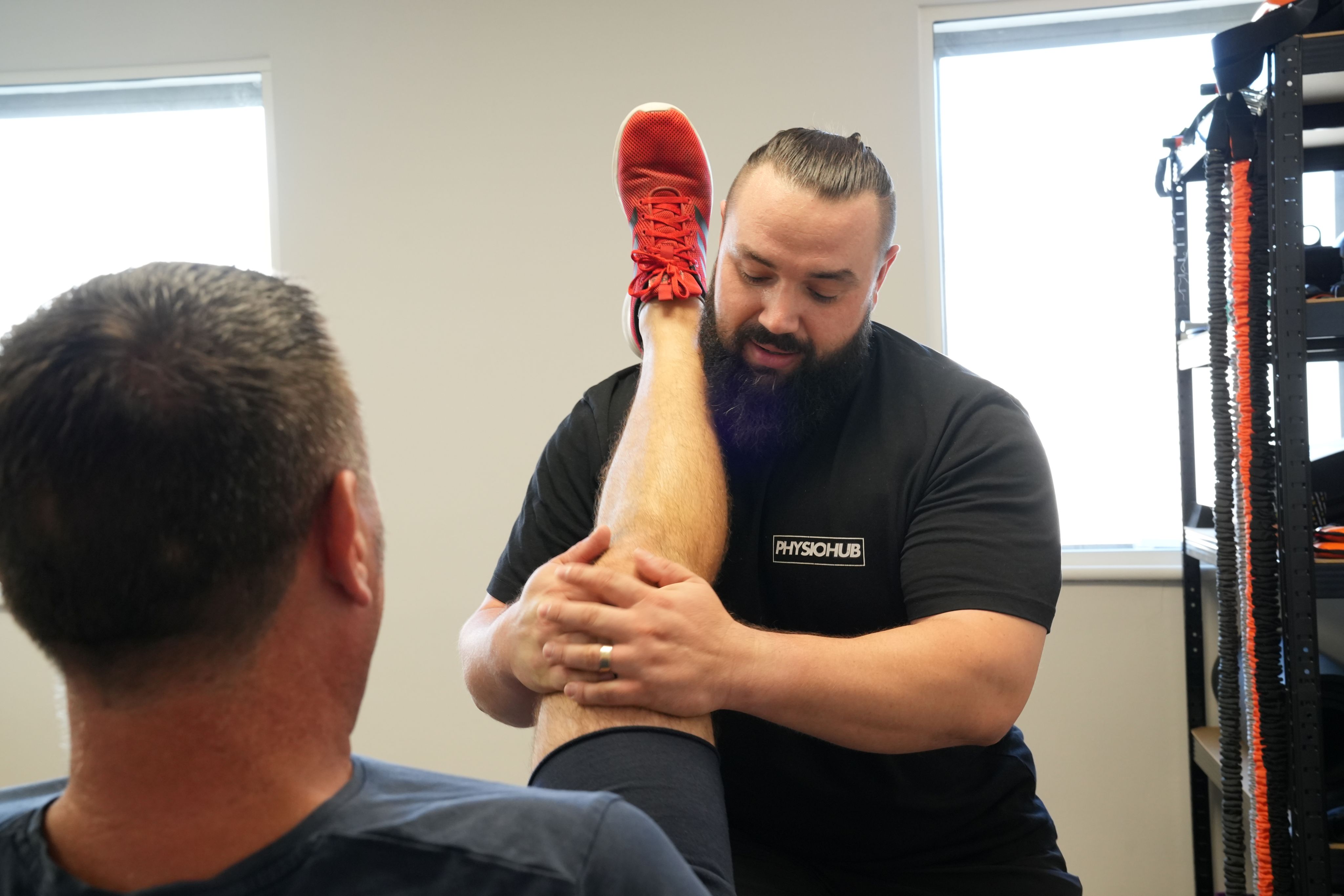
The order below moves from the hardest-working joints to the smallest, and it is ranked by how much range each move gives back per minute spent. Thirty seconds per side is the standard hold, which makes the whole thing just under ten minutes.
| Minute | Move | What it opens | Hold |
|---|---|---|---|
| 0–3 | 1. Low lunge with thoracic rotation | Hip flexors, groin, mid-back | 45 seconds per side |
| 3–4 | 2. Doorway chest stretch | Chest and front of shoulder | 30 seconds × 2 |
| 4–5.5 | 3. Cat-cow into child’s pose | The whole spine | 10 cycles, then 30 seconds |
| 5.5–7 | 4. Figure-four glute stretch | Deep buttock muscles | 30 seconds per side |
| 7–8 | 5. Standing overhead side reach | Ribs, lats, side of the trunk | 30 seconds per side |
| 8–9 | 6. Hamstring hinge sweep | Back of the thigh | 30 seconds per side |
| 9–10 | 7. Calf wall stretch | Calf and Achilles | 30 seconds per side |
If you only have five minutes, do moves one, three and seven. Those cover the hips, the spine and the ankles, which is where most people lose range first.
This is a documentary review of published trial evidence rather than a routine prescribed for you. Around twenty stretches were considered, including the seven here plus the standing quad stretch, seated forward fold, pigeon pose, butterfly, sleeper stretch, neck side flexion, wrist extensor stretch, downward dog, thread the needle, couch stretch and the classic seated hamstring stretch.
Three criteria decided the order: how many joints and tissues each move reaches, how many people can perform it without equipment or floor space, and how much range it returns per minute spent.
The sources read were Bandy, Irion and Briggler’s 1997 trial in Physical Therapy, which compared stretch durations and frequencies in 93 people over six weeks, and the 2014 meta-analysis by Lauersen and colleagues in the British Journal of Sports Medicine, covering 25 trials, 26,610 participants and 3,464 injuries. Evidence checked in August 2026.
What could not be checked: no trial has compared these seven against each other, and the flexibility research is dominated by hamstring studies, so the hold times here are extrapolated to other muscles. The most important limitation is what stretching does not do, which the Lauersen analysis is clear about: it did not reduce injury rates, while strength training did. A stretch that reproduces a sharp pain, produces pins and needles, or is being used to manage a joint that keeps giving way needs assessing rather than repeating.
Pick multi-joint moves over isolated ones. The lunge with rotation covers the hip flexors, the groin and the mid-back in one position, which is why it is worth three of the ten minutes on its own.
Aim at what your day does to you. A desk produces short chest muscles, stiff mid-backs and tight hip flexors. Standing all day produces tight calves and sore glutes. Driving produces both. Choosing by your day beats choosing by a template.
Thirty seconds is the number. Longer holds do not produce more range, and much shorter ones do not produce enough. Consistency across weeks is what moves the needle.
Do not expect this to protect you. Range and comfort are what a stretching routine buys. Injury risk is reduced by loading tissues, not by lengthening them, which is worth knowing before you swap a strength session for this one.
What it is
A deep forward lunge with the back knee down, the front foot flat and the trunk rotating open towards the front leg.
Who it suits
Anyone who sits for most of the day, and anyone who has time for only one stretch.
How to do it
Step one foot well forward and lower the back knee to the floor. Push the hips gently forward until a stretch appears at the front of the back hip. Place the hand inside the front foot on the floor, then reach the other arm up towards the ceiling, turning the chest to follow it. Hold 45 seconds, then swap sides.
What the evidence supports
Range work of this kind produces measurable increases in joint range within three to six weeks when done most days, in line with the timelines in the stretching literature. Its main claim is efficiency rather than superiority: it reaches three areas at once that would otherwise take three separate stretches.
Limits and cautions
Letting the lower back arch to feel more at the front hip moves the stretch to the wrong place. Tucking the tailbone slightly under fixes it. A cushion under the back knee makes it possible on a hard floor.
Time and effort
Three minutes for both sides, on the floor.
Why it made the list
It ranks first because it covers the most ground per minute of any stretch here, and because the hip flexors and mid-back are the two areas a desk job stiffens most reliably.
What it is
Standing in a doorway with the forearms on the frame and stepping gently through it.
Who it suits
Desk workers, drivers, and anyone whose shoulders round forward by the end of the afternoon.
How to do it
Place both forearms on the door frame with the elbows at about shoulder height. Step one foot through the doorway and lean forward until a stretch appears across the chest and the front of the shoulders. Hold 30 seconds, twice. Raising or lowering the elbows changes which part of the chest muscle is stretched.
What the evidence supports
Short, tight chest muscles pull the shoulder blades forward around the ribcage, which reduces the space available when the arm goes overhead. Restoring that range is a routine part of shoulder programmes, though a stretch on its own rarely changes resting posture in the way it is often sold as doing.
Limits and cautions
Anyone with shoulder pain that has come on gradually should be cautious with the high elbow version, which pushes the joint into the position that tends to be irritable. Lower the elbows to below shoulder height instead.
Time and effort
One minute, in any doorway.
Why it made the list
It reaches an area almost nothing else in a home routine reaches, and it takes a minute.
What it is
Alternately arching and rounding the spine on hands and knees, then sitting back onto the heels with the arms stretched forward.
Who it suits
Everyone, including people with a currently sore back, since the range is entirely under your control.
How to do it
Hands under shoulders, knees under hips. Round the back upwards, then reverse into a gentle arch, moving slowly and segment by segment. Ten cycles. Then sit the hips back towards the heels, reach the arms forward and hold for 30 seconds, breathing into the back of the ribs.
What the evidence supports
Movement through range in both directions is standard advice for a stiff spine, and NICE guidance on low back pain puts exercise and continued activity at the centre of management. This is a mobility exercise rather than one with its own trial evidence.
Limits and cautions
Rushing turns it into a rock from the hips rather than movement through the spine. Sore knees are the usual obstacle, and a cushion behind the knees or doing the cat-cow half seated on a chair solves it.
Time and effort
Ninety seconds, on a mat.
Why it made the list
It is the most reliably comfortable spinal movement there is, and it works when a back is currently sore, which is the week most people need it.
What it is
Lying on your back with one ankle crossed over the opposite knee, drawing the supporting thigh towards you.
Who it suits
Anyone who sits for long periods, and anyone with a deep ache in one buttock after driving.
How to do it
Lie on your back, knees bent. Cross the right ankle over the left knee, then reach through and pull the left thigh towards your chest until a stretch appears deep in the right buttock. Hold 30 seconds and swap. A seated version works on a chair for anyone who cannot get onto the floor.
What the evidence supports
The muscles in the deep buttock shorten during long periods of sitting and are a common source of a dull ache that people mistake for a back problem. Stretching them eases that ache, and it does not treat sciatica, where symptoms travel down the leg from the spine.
Limits and cautions
Symptoms that shoot down the back of the leg during the stretch mean stopping and getting it looked at. Anyone with a painful outer hip on the bony point should be careful, since pulling the knee across the body compresses exactly that area.
Time and effort
Ninety seconds, on the floor or a chair.
Why it made the list
It reaches the area most affected by sitting, and it has a seated version, which is unusual on this list.
What it is
Standing tall, reaching both arms overhead and leaning to one side.
Who it suits
Anyone who wants a stretch that can be done at a desk or in a kitchen without changing clothes.
How to do it
Feet hip-width apart. Reach both arms overhead, take hold of one wrist, and lean away from that side until a stretch runs down the ribs and the side of the trunk. Breathe into the stretched side. Hold 30 seconds and swap.
What the evidence supports
This reaches the large muscle running from the arm to the lower back and the muscles between the ribs, both of which restrict overhead reach and rib expansion when short. It is a general mobility move rather than a treatment for any specific condition.
Limits and cautions
Leaning forwards as well as sideways is the usual drift, and it takes the stretch out of the target area. Keeping the hips level and the chest facing forwards keeps it honest.
Time and effort
One minute, standing anywhere.
Why it made the list
It is the only move here that needs no floor, no wall and no doorway, which makes it the one that survives a busy day.
What it is
Standing with one heel forward on the floor and hinging at the hips over that leg, keeping the back long.
Who it suits
Anyone whose hamstrings feel tight, particularly runners and cyclists.
How to do it
Place one heel a short step in front with the toes lifted. Keeping that knee straight and the back flat, push the hips backwards and hinge forwards until a stretch appears behind the thigh. Hold 30 seconds and swap. Hinging from the hips rather than rounding the back is the entire technique.
What the evidence supports
The hamstrings are the muscle group the stretching evidence is built on. Bandy’s 1997 trial found 30 second holds, five days a week for six weeks, produced the range gains, with 60 seconds adding nothing. Our full guide to hamstring stretching exercises compares the alternatives.
Limits and cautions
Rounding the back moves the stretch into the lower back and out of the hamstring, which is the single most common fault in any hamstring stretch. Anyone with current back pain should use a lying version with a strap instead.
Time and effort
One minute, standing.
Why it made the list
It is the best-evidenced stretch in the routine and the one people most often ask about, though the hinge technique takes a session or two to get right.
What it is
Hands on a wall, one leg back with the heel down, leaning forwards.
Who it suits
Everyone, and particularly anyone who wears heeled or stiff shoes, walks a lot, or has had heel or Achilles pain.
How to do it
Hands on a wall, one foot back with the heel down and toes pointing forwards. Lean in until a stretch appears in the upper calf. Hold 30 seconds. Then bend the back knee a little and hold again, which moves the stretch down towards the Achilles. Swap sides.
What the evidence supports
Ankle range is one of the few flexibility measures that clearly limits everyday movement, since it determines how far the shin can travel forward when you squat, walk downhill or descend stairs. Restricted ankles push work up into the knee and down into the arch, which is why this stretch appears in both knee and foot programmes.
Limits and cautions
A heel that lifts off the floor cancels the stretch. Skipping the bent-knee version misses the lower half of the calf. Anyone currently in a flare of Achilles pain should keep the range gentle.
Time and effort
One minute, against any wall.
Why it made the list
It closes the routine because ankle stiffness has more downstream effects than any other single restriction here, and it is easy to keep up.
| Move | Main target | Needs floor | Can be done at work | Equipment | Time |
|---|---|---|---|---|---|
| Low lunge with rotation | Hip flexors, groin, mid-back | Yes | No | Cushion helps | 3 min |
| Doorway chest stretch | Chest and front of shoulder | No | Yes | A doorway | 1 min |
| Cat-cow into child’s pose | Whole spine | Yes | Seated version only | Mat | 1.5 min |
| Figure-four glute stretch | Deep buttock | Preferably | Seated version | None | 1.5 min |
| Overhead side reach | Ribs and lats | No | Yes | None | 1 min |
| Hamstring hinge sweep | Back of thigh | No | Yes | None | 1 min |
| Calf wall stretch | Calf and Achilles | No | Yes | A wall | 1 min |
Five of the seven can be done in work clothes against a wall or a doorway, which is what makes a daily habit realistic.
If you sit at a desk all day, prioritise the lunge with rotation, the doorway chest stretch and the figure-four. Those three answer what sitting does.
If you stand or walk all day, prioritise the calf stretch, the hamstring hinge and cat-cow.
If you have five minutes, do the lunge with rotation, cat-cow into child’s pose, and the calf stretch. Hips, spine, ankles.
If you are stretching to avoid injury, spend the ten minutes on strength work instead. That is where the evidence is, and our guide to injury prevention exercises covers what to do with it.
If a stretch reproduces a sharp, specific pain rather than a broad pull, stop doing that one. A stretch that keeps hurting the same spot is telling you something a routine cannot fix.
If you are warming up for sport, leave the long holds until afterwards and use movement through range instead.
Uckfield Runners have been going since 1991 and train out of Freedom Leisure, which makes them a good barometer of what a mixed local running group actually brings into a clinic. What arrives is rarely a flexibility problem. It is calves and Achilles tendons complaining after a jump in mileage, knees that object when hill work goes up, and hamstrings that grumble in the first weeks of speed sessions. The stretching routine most people have already tried was not the missing piece in any of them.
The clinical point sits in the gap between what a stretching routine is good at and what people hope it will do. Range and comfort respond well to daily stretching. Injury risk responds to load management and to strength work, which is what the meta-analysis above found across 25 trials. A ten-minute daily routine is worth keeping for how it makes you move and feel, alongside two strength sessions a week rather than instead of them.
Where one particular stretch keeps reproducing the same sharp pain in the same spot, booking an assessment answers what that is faster than another six weeks of stretching it.
How long should you hold each stretch?
Thirty seconds. Bandy and colleagues compared 30 and 60 second holds in 93 people stretching five days a week for six weeks, and found no extra range from the longer hold. Holding for a full minute is not harmful, and it costs you time that buys nothing.
Is it better to stretch in the morning or at night?
Either works, and the difference is in how it feels rather than in the result. Morning stretching gets more out of a body that has been still for eight hours. Evening stretching is more comfortable because the tissues are already warm. The routine that gets done is the better one.
Does stretching prevent injuries?
The evidence says no, or at most very little. A 2014 meta-analysis by Lauersen and colleagues pooled 25 trials covering 26,610 participants and 3,464 injuries, and found stretching produced no significant reduction in injury rates. Strength training in the same analysis cut sports injuries to under a third, and almost halved overuse injuries. Stretch for comfort and range, and train for injury prevention.
Should stretching be painful?
No. The right sensation is a strong pull in the middle of the muscle that eases as you hold it. Sharp, pinching, burning or electric sensations, or anything that produces pins and needles, means backing off. Pain during a stretch is a common reason people give up on a routine that would otherwise have worked.
Can you stretch every day?
Yes, and daily is what produces the range gains. Bandy’s trial ran five days a week for six weeks, and it found no additional benefit from stretching three times a day rather than once. Once a day, most days, is the practical target.
How long before stretching improves flexibility?
Three to six weeks for a measurable change in range, and the first improvements are noticeable within about two. The gains fade if you stop, typically within four to six weeks, which is why flexibility works like fitness rather than like a repair.
Should I stretch before or after exercise?
Save the long static holds for after, or for a separate session. Holding a stretch for a minute or more immediately before an activity that needs power measurably reduces force output for a short period. A warm-up is better spent on movements that raise the temperature and take the joints through range without long holds.
PhysioHub – Empowerment through Evidence-Based Education.
Every body is different. Book a thorough assessment and get advice that is specific to you and your goals.
Book an Appointment