
After a fall, an operation or a spell in hospital, older adults lose strength remarkably quickly, and the weeks that follow decide how much of it comes back. Families searching for rehab centres or rehab facilities for seniors are usually trying to answer one question: what will get Mum or Dad back to independent living? Here are the options in the UK and what the evidence supports.
Where the need follows a stroke, PhysioHub's guide to private stroke rehabilitation covers what to look for.
Many people move between these. The risk point is the handover, when NHS reablement finishes at six weeks and nothing replaces it, which is often exactly when strength work should be starting in earnest.
Two capacities decide whether someone lives independently: leg strength and balance. Both respond to training well into the eighties and nineties, and both decline fast during a hospital stay or a period of sitting still.
The UK Chief Medical Officers' physical activity guidelines recommend that older adults do activities to improve strength, balance and flexibility on at least two days a week, alongside 150 minutes of moderate activity, and they are explicit that any activity is better than none (UK CMO guidelines). For someone recovering from illness or a fall, that translates into sit-to-stands, step-ups, resisted leg work and standing balance practice, progressed as capacity improves.
Chair-based exercise and walking have their place for confidence and endurance. On their own they rarely produce the strength gains needed to rise from a low chair, climb stairs or recover from a stumble.
A fall often costs more in confidence than in tissue. Fear of falling leads to less walking, less strength and a higher risk of the next fall, which is a loop worth breaking early. Good rehabilitation addresses the physical side (strength, balance, gait, footwear, walking aids set to the right height) and the behavioural side (graded exposure to the situations that now feel risky, and a plan for getting up from the floor).
It is also worth having medication, vision, blood pressure and home hazards reviewed, as these are common contributors that exercise alone will not fix. A GP can arrange a falls assessment.
What has changed most in this part of the work is the ambition behind it. Strength and balance provision for older adults across East Sussex has grown, with Age UK East Sussex classes and Otago-based programmes running in the community, and the evidence sitting under them is strong enough that falling is now treated as something trainable. What has not kept pace is the option for people who need more than a class: someone whose reablement block has finished, who has become slower on the stairs, and who has quietly stopped going out alone.
Strength in this age group follows the same rules as everybody else's, which tends to surprise families. It has to be loaded to change, and it has to keep getting harder. Gentle repetitions of the same few movements will hold a level steady, while getting out of an armchair without a push, carrying shopping in from the car and managing the stairs at night come from work that measurably progresses week by week, with the gains tracked so the person and their family can see them.
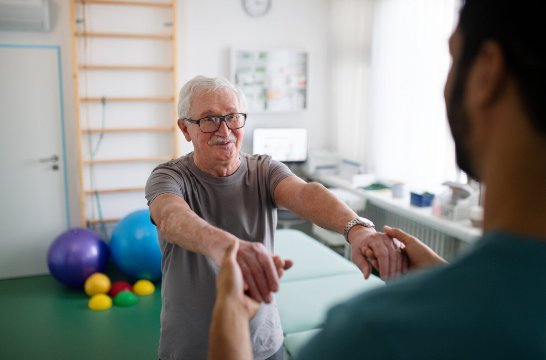
Our gym-based 1:1 rehab and strength training sessions deliver that strength and balance work at an individual pace, with home visits where getting out is the obstacle.
Is 85 too old to build strength?
No. Muscle responds to resistance training across the lifespan, and improvements in strength, walking speed and balance are well documented in people in their eighties and nineties.
Home visits or clinic sessions?
Home is better when travel is difficult or when the goals are about the house itself. The clinic is better for progressive loading, since equipment allows the resistance to keep increasing. Many people start at home and move to the clinic as they improve.
How soon should rehab start after a hospital stay?
As soon as it is safe. Strength is lost fastest in the first weeks of inactivity, and early guided loading limits how much has to be rebuilt later.
PhysioHub – Empowerment through Evidence-Based Education.
Every body is different. Book a thorough assessment and get advice that is specific to you and your goals.
Book an Appointment