
Five exercises cover most shoulder pain that has come on without an injury: side-lying external rotation, an isometric wall push, band pull-aparts, wall slides and pendulum swings. Do the loaded ones three to four times a week and the gentle movement daily. Add weight only when a movement has been comfortable for a week, and add it 0.5kg at a time.
Where the pain arrives overhead and no single injury explains it, the umbrella term for that pattern is unpicked in PhysioHub’s guide to rotator cuff-related shoulder pain.
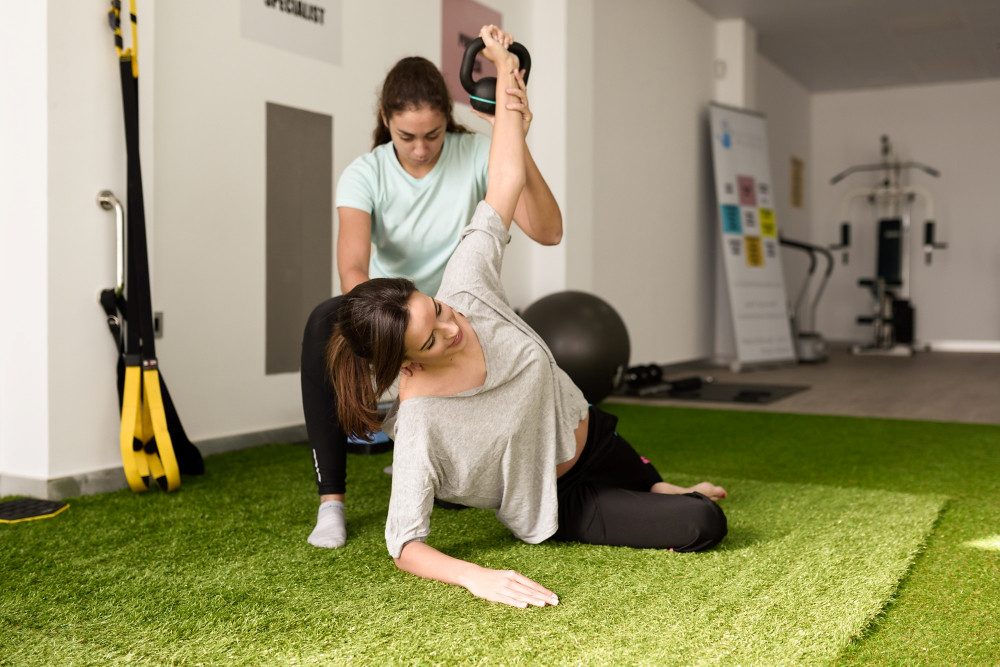
These are ranked on how much rotator cuff and shoulder blade strength each one builds, weighed against how many people can do it while the shoulder is painful. Where the shoulder is very sore, start at number five and climb the list.
| Exercise | Best for | Frequency and dose | Add load when |
|---|---|---|---|
| 1. Side-lying external rotation | The rotator cuff itself | 3× weekly, 3 × 12 | 15 reps with 0.5kg feel controlled |
| 2. Isometric wall push | Loading a sore tendon without movement | Daily, 4 × 30 second holds | Pain sits at 3/10 or below, then move to bands |
| 3. Band pull-apart | Muscles between the shoulder blades | 3× weekly, 3 × 15 | 15 reps feel easy, then a stronger band |
| 4. Wall slide | Shoulder blade control overhead | 3× weekly, 3 × 10 | Full range is comfortable, then add a mini-band |
| 5. Pendulum swing | Keeping a very painful shoulder moving | Daily, 2 minutes | Never, this one stays unloaded |
All five take about 20 minutes. Two sessions a week of the top three plus daily pendulums is a realistic minimum that still works.
This is a documentary review of published trial evidence rather than a programme prescribed for your shoulder. Around eighteen exercises commonly given for shoulder pain were considered, including the five here plus internal rotation with a band, prone Y and T raises, scaption raises, the sleeper stretch, cross-body stretches, full can raises, serratus punches, press-up plus, rowing variations, wall walks and pulley-assisted elevation.
Three criteria decided the ranking: how directly the exercise loads the rotator cuff and the muscles that position the shoulder blade, how far it progresses over months, and how many people can perform it while the shoulder is painful.
The sources read were the GRASP trial, a UK randomised trial of 708 people with rotator cuff disorders, and the 2020 systematic review of isometric exercise for tendinopathy by Clifford and colleagues in BMJ Open Sport and Exercise Medicine. Evidence checked in August 2026.
What could not be checked: no trial has ranked these five against each other, and the honest headline from GRASP is that neither more physiotherapy sessions nor a steroid injection changed the 12-month result. A shoulder that came on after a fall or a heavy lift, one that cannot be lifted at all, or one with pins and needles down the arm needs assessing rather than training around.
Load the cuff, then control the shoulder blade. External rotation trains the tendons that are usually the source of the pain. The pull-apart and the wall slide train the muscles that set the position those tendons work in. A programme with only one of the two halves tends to plateau.
Separate daily movement from weekly loading. Pendulums and gentle range work are comfort and mobility, so they can be done every day. Strengthening needs the day in between to be useful.
Use pain as a dial, not a stop sign. Discomfort up to 3 out of 10 during a shoulder exercise, settling within 24 hours, is workable. Night pain that is worse after a session is the clearest sign the load was too much.
Give it three months before deciding it has failed. Shoulder problems are slow, and most of the improvement in the GRASP trial had arrived by around 12 weeks in both groups. A month is not a fair test.
What it is
Lying on your good side with the sore arm on top, elbow tucked into the waist and bent to 90 degrees, rotating the forearm upwards.
Who it suits
Almost anyone with shoulder pain that came on gradually, which covers the majority of shoulder problems seen in clinic.
How to do it
Lie on your side with a rolled towel between the elbow and your ribs. Keep the elbow pinned there and rotate the hand up towards the ceiling, stopping where the shoulder blade starts to move, then lower over three seconds. Three sets of 12, three times a week. Start with no weight, then progress to 0.5kg, then 1kg.
What the evidence supports
External rotation strengthening is the backbone of the exercise programmes tested in shoulder trials, including the progressive programme used in GRASP. Those programmes produced clear improvement in shoulder pain and disability over 12 months, in a condition that is often assumed to need injection or surgery.
Limits and cautions
Letting the elbow drift away from the body turns this into a different exercise. The towel solves it. Rotating past the point where the shoulder blade starts tipping backwards adds range without adding useful load.
Time and effort
Five minutes, on a bed or the floor.
Why it made the list
It ranks first because it loads the rotator cuff more directly than anything else that can be done at home, and because it scales in half-kilogram steps for months.
What it is
Standing side-on to a wall, elbow bent to 90 degrees and tucked in, pressing the back of the hand into the wall and holding.
Who it suits
A shoulder too painful for moving exercises, and the first two weeks of most programmes.
How to do it
Stand with the sore side next to a wall, elbow at your waist and bent to a right angle, a folded towel between hand and wall. Press outwards at about half your maximum effort and hold for 30 seconds. Four holds, once or twice a day. Move on to the side-lying version once the shoulder tolerates it.
What the evidence supports
Isometric holds let a painful tendon take load with no movement at the joint, which is why they are used as an entry point. The claim that they reliably relieve pain has weakened: a 2020 systematic review by Clifford and colleagues found isometric exercise was not superior to moving exercise for chronic tendinopathy, either immediately or within 12 weeks, and that the response varies a lot between individuals. It earns its place as a way in rather than as a painkiller.
Limits and cautions
Pushing at full effort in the first week usually backfires. Half effort is enough. Anyone who finds these irritate the shoulder should try holding at a smaller angle or drop to the pendulum.
Time and effort
Four minutes, against any wall.
Why it made the list
It ranks second because it is the most reliable way to start loading a shoulder that will not tolerate movement yet, even though the pain-relief case for it is weaker than it is often presented.
What it is
Holding a resistance band in front of you at chest height with straight arms, and pulling it apart until the arms are out to the sides.
Who it suits
Anyone who spends the day at a desk, and anyone whose shoulder tires quickly rather than hurting sharply.
How to do it
Arms straight out in front, hands shoulder-width on a light band. Pull the band apart by drawing the shoulder blades together, stopping when the arms are level with your body, then return slowly. Three sets of 15, three times a week. Progress by moving the hands closer together or moving up a band.
What the evidence supports
The muscles between and below the shoulder blades set the position the rotator cuff works from, and they fatigue in anyone who spends long periods with the arms forward. Strengthening them sits alongside cuff work in most of the exercise programmes tested for shoulder pain, and it is the part people usually skip.
Limits and cautions
Shrugging towards the ears or arching the lower back to finish the movement are the two faults worth watching. Both mean the band is too strong for now.
Time and effort
Four minutes, and one band.
Why it made the list
It builds the supporting half of the shoulder with almost no risk of aggravation, which makes it available in weeks when overhead work is not.
What it is
Standing facing a wall with the forearms on it, sliding them upwards while keeping contact, then pressing forwards at the top.
Who it suits
Anyone whose shoulder hurts overhead, and anyone rebuilding towards reaching high shelves, painting or racket sport.
How to do it
Forearms on the wall a little wider than your shoulders, elbows at about chest height. Slide up as far as the shoulder allows without shrugging or arching, press gently into the wall at the top for a second, then slide down. Three sets of 10, three times a week. Progress by adding a mini-band around the wrists.
What the evidence supports
This trains the muscle that pulls the shoulder blade around the ribcage as the arm goes up, which is the movement most often lost in a shoulder that has been painful for months. The wall gives feedback and takes some of the arm’s weight, so range can be built well before overhead lifting is comfortable.
Limits and cautions
Sliding higher by leaning back or hitching the shoulder defeats the purpose. Stop where the movement stays clean. Anyone with a genuinely stiff shoulder, where range is limited in every direction including when someone else moves the arm, needs a different programme.
Time and effort
Four minutes, against any wall.
Why it made the list
It is the safest way to rebuild overhead movement, and it bridges the gap between the floor exercises above and real overhead loading.
What it is
Leaning forward with the sore arm hanging down, and letting it swing gently in small circles and lines using body movement rather than shoulder muscle.
Who it suits
A shoulder in an acute flare-up, the first days after many shoulder operations, and anyone whose shoulder is too painful for the other four.
How to do it
Rest the good hand on a table and let the sore arm hang. Shift your weight to make the arm swing forwards and backwards, side to side, then in small circles. Two minutes, once or twice a day. This one is never loaded.
What the evidence supports
Pendulums keep the joint moving with almost no muscular demand, which is why they appear in early post-operative protocols. They are a comfort and mobility measure, and there is no evidence that they build strength or change the long-term outcome on their own.
Limits and cautions
Actively swinging the arm with the shoulder muscles removes the point of the exercise. The movement comes from the body. Doing pendulums alone for weeks is the trap, because the shoulder stays comfortable and stays weak.
Time and effort
Two minutes, anywhere.
Why it made the list
It ranks last on strength built and first on availability. It is what keeps a shoulder moving in the week when nothing else is tolerable.
| Exercise | Main target | Movement at the joint | Usable in a flare-up | Equipment | Room to progress |
|---|---|---|---|---|---|
| Side-lying external rotation | Rotator cuff | Yes, small range | Once settling | Towel, light weight later | High |
| Isometric wall push | Rotator cuff | None | Yes | A wall | Low |
| Band pull-apart | Mid-back and shoulder blade | Yes | Usually | Resistance band | High |
| Wall slide | Serratus anterior and lower trapezius | Yes, overhead | Sometimes | A wall | Moderate |
| Pendulum swing | Joint movement only | Yes, passive | Yes, this is the starting point | None | None |
The fourth column decides where you start. Three of the five stay available in a bad week, and only one of those builds real strength, which is why the isometric hold does so much work early on.
If the shoulder aches all night and hurts at rest, do pendulums and the isometric wall push only, and add side-lying rotation once the night pain starts easing.
If the pain arrives partway through lifting the arm, prioritise side-lying external rotation and wall slides. That combination targets both the tendon and the position it works in.
If your shoulder tires at a desk rather than hurting sharply, band pull-aparts and wall slides matter most, done little and often across the week.
If you are returning to racket sport or overhead lifting, run all five, and read our guide to physiotherapy for a rotator cuff injury before adding overhead load back.
If the shoulder is stiff in every direction, including when someone else lifts the arm, this programme is the wrong one. That pattern points towards a frozen shoulder, which follows a different course.
If the arm went weak after a fall or a heavy lift, get it assessed. Sudden weakness after trauma is one of the few shoulder presentations where waiting is a poor idea.
How often should you do exercises for shoulder pain?
Do the loaded exercises three to four times a week on alternate days, and gentle movement such as pendulums daily or twice daily. Alternate days matter because the tendon needs time between sessions to respond to the load. Doing the strengthening every day is one of the more common ways a shoulder programme stalls.
When is it safe to add weight to shoulder exercises?
Add weight when three things are true for a full week: the movement is comfortable at 2 out of 10 or less, there is no flare-up or night ache in the 24 hours afterwards, and you can do it without shrugging the shoulder or bracing the neck. Increase by 0.5kg to 1kg at a time, or by moving to the next band up.
Why does my shoulder hurt when I lift my arm overhead?
Pain that arrives partway through raising the arm and eases again near the top is the classic pattern for rotator cuff-related shoulder pain. The tendons and the small fluid-filled sac above them are compressed most in that middle range. Strengthening the cuff improves how the arm bone sits in the socket during the movement, which is why exercise rather than rest is the standard first treatment.
How long do shoulder exercises take to work?
Expect meaningful change at 6 to 12 weeks. The GRASP trial followed 708 people with rotator cuff disorders over a full year, and most of the improvement in both treatment groups had happened by around three months. Judging a shoulder programme at four weeks is judging it too early.
Do I need physiotherapy sessions, or can I do this at home?
The GRASP trial compared up to six physiotherapy sessions with a single session plus a home programme, and found no difference in shoulder pain and disability over 12 months. What that suggests is that doing the exercises consistently matters more than how many appointments you attend. An assessment still earns its place where the diagnosis is unclear or the shoulder is not responding.
Should I have a steroid injection for shoulder pain?
It is a reasonable option for settling pain enough to start exercising, though it does not appear to change where you end up. The same trial found no difference at 12 months between people who had a subacromial corticosteroid injection and those who did not. That makes it a tool for the first few weeks rather than a treatment in its own right.
Which shoulder exercises should I avoid?
In the early weeks, avoid overhead pressing, upright rows, dips and any movement that reproduces a sharp catch in the middle of the range. Stretching into the painful position aggressively is also worth leaving alone. Almost everything else stays available, including all five exercises here, most rowing variations and lower-body training.
PhysioHub – Empowerment through Evidence-Based Education.
Shoulder pain has several common causes that respond to different loading, and our guide to shoulder pain covers how they are separated.