
If you are pricing up a private ACL reconstruction, the surgical quote is only part of the picture. The rehabilitation that follows runs for nine to twelve months, costs real money, and has more influence on whether you get back to sport safely than the choice of surgeon. Here is how the costs break down and what to check before you commit.
Costs and recovery for the other knee operation people weigh up privately are set out in PhysioHub's guide to private meniscus surgery.
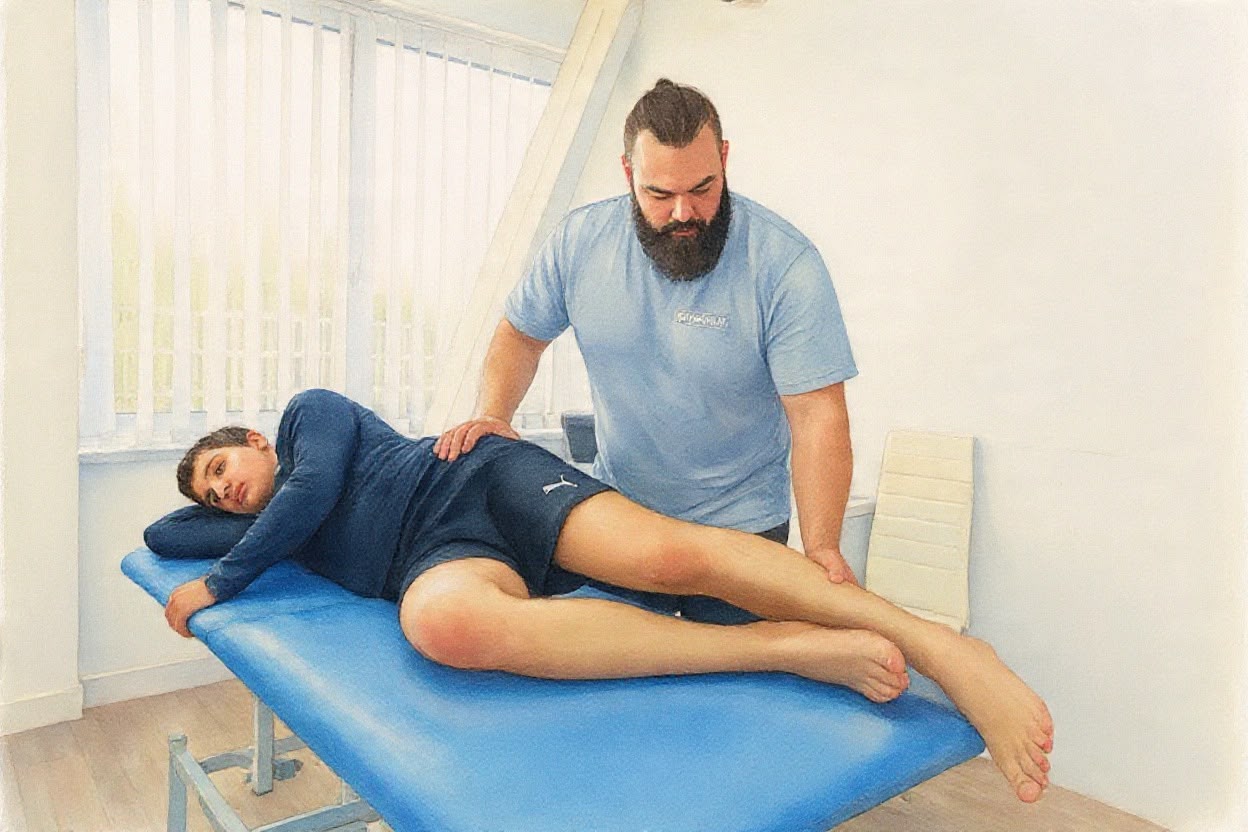
The anterior cruciate ligament runs diagonally through the middle of the knee and stops the shin bone sliding forward on the thigh bone or rotating away from it. It is usually torn without contact: a pivot, a sudden deceleration, or a landing where the knee collapses inwards. Many people describe a pop, immediate swelling within a few hours, and a knee that feels unreliable for weeks afterwards.
A fully ruptured ACL does not reliably heal back to a functional ligament, so reconstruction replaces it with a graft, most often taken from the hamstring tendons, the patellar tendon or the quadriceps tendon. The operation is offered chiefly to restore rotational stability for people who want to return to pivoting sport such as football, netball, rugby, skiing or racquet sports, and for people whose knee gives way in ordinary life.
Reconstruction is not automatic. Whether you need it turns on how stable the knee proves once swelling settles and strength returns, on any meniscal or cartilage damage found alongside it, and on the demands you intend to put on the knee. A structured rehabilitation trial first is a reasonable route for many people who do not play pivoting sport, and it costs a fraction of the surgical pathway.
Where the knee trouble started without a pop, a pivot or rapid swelling, our guide to knee pain covers the more common causes and how they are told apart.
A private ACL reconstruction package in the UK is normally built from the same components, though providers bundle them differently:
Quotes vary widely by region, hospital group and surgeon, so ask for an itemised, fixed-price quote in writing and check specifically what happens if you need extra appointments. It is also worth asking what the package covers if a complication arises.
Published prices are scarcer than you would expect, because most hospital groups quote only after a consultation. The figures that are published give a useful floor. Practice Plus Group lists ACL reconstruction at a fixed price of £7,399 as of August 2026, with the initial consultation charged separately at £145 and diagnostic scans arising from that consultation excluded. Their fixed price does cover consultant fees throughout, the anaesthetic, any overnight stay, and post-operative appointments.
Premium hospital groups sit higher, and specialist London clinics higher again, particularly where a donor graft rather than your own tissue is used. Treat any single headline figure with caution and price your own case, because graft choice, region, hospital group and whether an MRI is already done all move the number by thousands.
Three questions separate a real quote from a marketing figure:
Ask about payment terms directly. Some providers will discuss a reduction for settling in full up front, and finance arrangements are commonly offered through third-party lenders. Neither is usually advertised, so it is a question rather than a listed option, and the sum involved is small next to the difference a properly funded rehabilitation phase makes.
ACL rehabilitation runs for roughly nine to twelve months. A handful of included sessions covers the first few weeks and little else. Realistically you are looking at regular supervised sessions through the early phase, then a lower frequency of review and progression appointments across the strength and return-to-sport stages, alongside gym access.
Budget for that from the start. Spending heavily on surgery and then rationing rehabilitation is the most common way people end up with a stable knee they still do not trust.
Once the surgical package is spent, the remaining spending falls into three lines, and only one of them is genuinely unavoidable.
Physiotherapy beyond the included sessions. This is the one that decides your outcome. Expect weekly or fortnightly supervised sessions through the first three months, then reviews at a lower frequency as the programme moves into heavy strength work and running, with a further cluster around return-to-sport testing. Price it from your own clinic's session rate multiplied across that timeline rather than from a headline figure, and price it before you book the surgery.
Somewhere to train. A gym membership or a modest set of home equipment is a real cost, because the strength phase needs progressive external load. This is where a rehabilitation programme either becomes strong enough to pass return-to-sport criteria or quietly stalls.
Bracing and crutches. Crutches are usually supplied. A functional brace often is not, and the evidence for buying one is weak: a 2025 systematic review and meta-analysis in Arthroscopy pooled 14 studies and 1,199 patients and found that rehabilitative bracing made no significant difference to thigh muscle strength, knee range of movement, laxity, hop testing or patient-reported scores. Ask your surgeon whether a brace is required for your specific graft and fixation. Where it is optional, that money buys more recovery spent on supervised strength work.
The evidence on this is unusually clear. In the Delaware-Oslo ACL cohort study, the reinjury rate fell by 51% for each month that return to sport was delayed up to nine months after surgery, and athletes who failed return-to-sport criteria had a reinjury rate of 38.2% compared with 5.6% in those who passed. Combining a delay to nine months with passing objective criteria was associated with an 84% reduction in reinjury risk.
Two things follow from that. First, the calendar and how the knee feels are weak evidence on their own. Second, quadriceps strength symmetry, hop testing and movement quality need to be measured before you go back to pivoting sport. A service that cannot test you cannot clear you.
The operation itself is short. ACL reconstruction is typically arthroscopic, takes on the order of an hour to two hours under general anaesthetic, and is often done as a day case or with a single overnight stay. Most people are walking with crutches the same day.
The recovery is the long part, and it is staged rather than continuous:
Nine months is the earliest realistic point for a return to pivoting sport for most people, and later is common. That timeline is why the rehabilitation budget matters more than the difference between two surgeons' fees.
The knee that goes into surgery with full extension, minimal swelling and decent quadriceps activation comes out ahead. Prehab typically means a few weeks of restoring range of movement, settling swelling and rebuilding quadriceps and hamstring strength, and it is standard practice in most good pathways.
It also gives you information. Some people with an ACL rupture who are not returning to pivoting sport do well with structured rehabilitation and no reconstruction, and a proper prehab period is when that conversation can be had honestly.
ACL reconstruction is available on the NHS, and the surgery itself is done to the same standard. The usual reasons people go private are waiting times and the scheduling control that matters when you are trying to fit a nine to twelve month rehab around a season, a job or a competition.
Insurance changes the arithmetic rather than removing it, and the fold below sets out where a policy typically runs short on an injury that takes the best part of a year to rehabilitate.
Most policies will cover ACL reconstruction as an acute condition once it is pre-authorised, and the surgical side of the claim is rarely where things go wrong. The costs that reach you are the excess, any shortfall between the surgeon's fee and what your insurer recognises, and the rehabilitation once the session allowance runs out.
Two features of how policies are written matter more here than for almost any other operation, because ACL rehabilitation runs nine to twelve months.
The first is the session cap. AXA Health's therapies cover, for example, pays for up to 10 sessions a year with a physiotherapist, with anything beyond that needing authorisation. Ten sessions covers the early phase and stops well short of the strength and return-to-sport work.
The second is how the excess resets. An AXA Health Plan excess is payable in full for each 12-month period in which you claim, and that period runs from when treatment starts, so a rehabilitation programme that crosses the anniversary can attract the excess twice for one injury. Ask your insurer to confirm this before your first appointment, along with whether a consultant referral is required to release physiotherapy benefit and which providers are in network.
Football and netball squads across Wealden come back into contact training through August, and a season's ACL injuries cluster in those first few weeks and again in the return-to-play weeks at the far end of somebody's rehab. Women's football has driven most of the public conversation about ACL injury in recent years, and grassroots clubs around Uckfield are where the same mechanism plays out every autumn with nobody on the touchline to catch it.
Cost is why a lot of people arrive here holding a plan they cannot finish. An ACL reconstruction is a nine to twelve month project and the operation is the short part of it. Cutting the strength phase to save money is how a knee ends up structurally repaired and functionally untrusted, giving way in someone's head long before it would on a pitch. Objective checkpoints for return to running, return to training and return to competition are what make the money already spent worth spending, and Alex, a HCPC-registered physiotherapist, sets those checkpoints from experience with runners and strength athletes rather than from the date on the calendar.
Our pre and post-surgical rehabilitation service covers those stages, and it is worth starting it before you choose a surgeon rather than after.
How much does private ACL surgery cost in the UK?
Providers quote a wide range depending on region, hospital, graft choice and what the package includes, so treat any single figure with caution and ask for an itemised fixed-price quote. The variable that most affects your budget is how much physiotherapy sits inside or outside the package.
Can I have surgery privately and rehab locally?
Yes, and many people do. Bring your operation note and your surgeon's protocol to your first physiotherapy appointment so the programme matches the graft and any fixation used.
Do I definitely need surgery after an ACL tear?
Not always. It depends on your knee's stability with rehabilitation, any associated meniscal or cartilage damage, and the demands of your sport. A structured rehabilitation trial is a reasonable first step for many people who do not play pivoting sport.
PhysioHub – Empowerment through Evidence-Based Education.
Every body is different. Book a thorough assessment and get advice that is specific to you and your goals.
Book an Appointment