
Five exercises cover most arch, heel and toe problems: high-load heel raises with a towel under the toes, the plantar fascia stretch, calf stretches with the knee straight and bent, short foot holds and toe yoga. Strength work goes every other day for 8 to 12 weeks. Stretching is daily, and it works faster but fades sooner.
Where the pain is spread across the foot rather than focused at the heel, the range of things that produce it is set out in PhysioHub’s guide to foot pain.
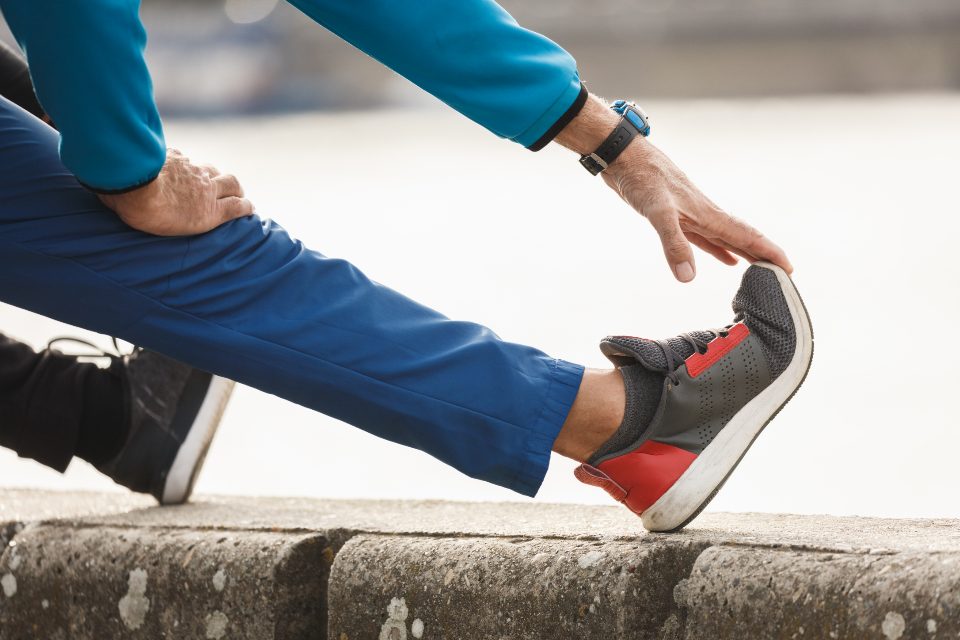
These are ranked on how much trial evidence supports them for foot and heel pain, weighed against how quickly they produce a change. The first two are the pair that most heel pain programmes are built from.
| Exercise | Best for | Dose | How quickly it helps |
|---|---|---|---|
| 1. High-load heel raise | Plantar heel pain and calf capacity | 3 × 12, every second day | Slower, holds up better |
| 2. Plantar fascia stretch | The first steps of the morning | 3 × 30 seconds, 3× daily | Fast, fades over months |
| 3. Calf wall stretch | Stiff ankles that overload the arch | 3 × 30–45 seconds per leg | Within days for stiffness |
| 4. Short foot hold | Arch control and foot strength | 3 × 10 holds of 5 seconds | About 8 weeks |
| 5. Toe yoga | Big toe control and push-off | 10–15 cycles per foot | Slow, mainly coordination |
All five take about 15 minutes on a strength day and five minutes on a stretch-only day.
This is a documentary review of published trial evidence rather than a programme prescribed for your foot. Around sixteen exercises commonly given for foot and heel pain were considered, including the five here plus towel curls, marble pickups, resisted ankle inversion and eversion, big toe extension stretches, seated heel raises, single-leg balance work, ball rolling, night splints, arch taping and barefoot walking progressions.
Three criteria decided the ranking: how directly the exercise is supported by trial evidence for painful feet, how quickly it produces a change, and how well the benefit holds over months.
The sources read were the Rathleff 2015 randomised trial of high-load strength training for plantar fasciitis, the DiGiovanni trial of plantar fascia-specific stretching with two-year follow-up, and systematic reviews of intrinsic foot muscle strengthening for arch function and balance. Evidence checked in August 2026.
What could not be checked: no trial has ranked these five against each other, the Rathleff trial had only 48 participants, and the evidence for intrinsic foot muscle training is graded low to very low certainty. Heel pain with numbness or pins and needles, pain that came on suddenly with a snap during activity, or a foot that cannot bear weight after an injury all need assessing rather than exercising.
Treat load capacity as the target, not flexibility. Most stubborn heel pain is a tissue being asked for more than it can currently give. Building what it can give is slower than stretching and it is what changes the six-month picture.
Check the ankle before blaming the foot. A calf that will not let the ankle bend far enough forces the arch to do more work at every step. Where the knee-to-wall test is limited, calf stretching earns a place it would not otherwise have.
Use stretching for the mornings and strength for the months. The two do different jobs, and running only the fast one is why so many heel pain programmes plateau at six weeks.
Give it a full 12 weeks before changing plan. Both landmark trials here measured at three months. Judging a foot programme at four weeks means judging it before either mechanism has finished working.
What it is
A slow heel raise performed with a rolled towel under the toes, so the toes are held bent upwards and the plantar fascia is put under tension as the heel rises.
Who it suits
Anyone with plantar heel pain that has lasted more than a few weeks, and anyone rebuilding after a period of reduced walking.
How to do it
Roll a towel and place it under the toes so they sit bent upwards. Rise onto the ball of the foot over three seconds, hold for two at the top, and lower over three seconds. Three sets of 12, every second day. Start on two legs and progress to one leg, then to standing on a step so the heel can drop below the toes, then to holding a rucksack with books in it.
What the evidence supports
This is the protocol tested by Rathleff and colleagues in 2015. Forty-eight people with ultrasound-confirmed plantar fasciitis were randomised to this or to plantar-specific stretching, both with shoe inserts. At three months the strength group scored 29 points better on the Foot Function Index, with a confidence interval running from 6 to 52 points. At six and twelve months there was no difference between the groups, so the honest reading is that it gets people better faster.
Limits and cautions
Rushing the tempo is what turns this from strength training into a calf warm-up. The eight-second rep is the exercise. Expect some discomfort during the first fortnight, and cut the load if the heel is worse the following morning.
Time and effort
Six minutes, every other day, with a towel and a step.
Why it made the list
It ranks first because it is the only exercise here with a randomised trial showing it beats the standard alternative, and because it keeps progressing for months.
What it is
Sitting with the ankle crossed over the opposite knee, pulling the toes back towards the shin while the other hand feels the tension along the arch.
Who it suits
Anyone whose first steps in the morning are the worst part of the day.
How to do it
Cross the sore foot over the opposite knee. Pull the toes, particularly the big toe, back towards the shin until a stretch appears along the arch, and hold for 30 seconds. Three holds, three times a day, with one of those before getting out of bed. Massaging along the arch with the thumb during the hold is part of the original protocol.
What the evidence supports
DiGiovanni and colleagues compared this stretch with a standard Achilles stretch in 82 people with chronic heel pain. At eight weeks the plantar fascia group had significantly better first-step pain and activity scores. At two years the two groups were the same, and 94 per cent of everyone reported less pain, which is a useful thing to know about the natural course of this problem.
Limits and cautions
Pulling only the small toes back misses the structure you are aiming at. The big toe is the one that tensions the arch. Sharp pain rather than a stretch means easing off, and a stretch that produces numbness or tingling into the toes needs a different explanation.
Time and effort
Five minutes across the day, seated, with nothing needed.
Why it made the list
It works fastest of anything here on morning pain, and morning pain is what most people with heel pain actually want dealt with.
What it is
The standard stretch with hands on a wall and one leg back, done once with the back knee straight and once with it bent.
Who it suits
Anyone whose ankle will not bend far forwards over the foot, which is common after any period in stiff shoes, after an ankle injury, and in most people with Achilles or heel pain.
How to do it
Hands on a wall, one foot back with the heel down and the toes pointing forwards. With the back knee straight, lean forwards until a stretch appears in the upper calf, and hold 30 to 45 seconds. Then bend the back knee slightly and repeat, which moves the stretch lower towards the Achilles. Three of each per leg, daily.
What the evidence supports
Thirty seconds is the useful hold length. Bandy and colleagues studied 93 people over six weeks and found that 30 seconds produced the range gains, with no further improvement from holding for 60 seconds. A restricted ankle transfers work to the arch at every step, which is the mechanism linking calf tightness to heel pain, though calf stretching on its own performed worse than strength work in the Rathleff trial.
Limits and cautions
Letting the back heel lift removes the stretch. Turning the back foot outwards does the same. Skipping the bent-knee version misses the lower calf muscle, which is the one closest to the heel.
Time and effort
Five minutes, against any wall.
Why it made the list
It is quick, it is the one thing on this list that changes within days, and it addresses a restriction that makes every other foot problem harder to fix.
What it is
Drawing the ball of the foot gently towards the heel to raise the arch, without curling the toes.
Who it suits
Anyone with an arch that collapses noticeably under load, and anyone whose foot fatigues after a day of standing.
How to do it
Sit with the foot flat on the floor. Keeping the toes long and flat, pull the ball of the foot towards the heel so the arch domes upwards. Hold five seconds and release. Three sets of 10. Progress from sitting to standing on two feet, then to standing on one.
What the evidence supports
Systematic reviews of intrinsic foot muscle strengthening report improved foot function in the short and medium term and changes in arch behaviour by around eight weeks, with no measurable change at four weeks. The certainty of that evidence is graded low to very low, so the honest framing is that this is a promising exercise with modest support rather than a proven one.
Limits and cautions
Curling the toes is the fault that makes this exercise do nothing, and almost everyone does it for the first week. The toes stay flat and long. Cramping in the arch is common early and settles.
Time and effort
Four minutes, sitting or standing, with nothing needed.
Why it made the list
It works the small muscles inside the foot itself, which no other exercise here targets directly, even though the evidence behind it is weaker than for the top three.
What it is
Lifting the big toe while the other four stay down, then reversing it.
Who it suits
Anyone with big toe stiffness or pain, and anyone whose push-off feels weak when walking or running.
How to do it
Foot flat on the floor. Lift the big toe only, keeping the other four pressed down, and hold two seconds. Then press the big toe down and lift the other four. Ten to 15 cycles per foot, daily. Most people cannot do it at all in the first week.
What the evidence supports
The big toe is what tensions the arch during the second half of each step, and control over it is part of how the foot stiffens itself for push-off. The case for training it separately is anatomical and clinical rather than trial-based, and it sits in the same low-certainty category as the short foot exercise.
Limits and cautions
Pressing the foot into the floor to fake the movement is the common workaround. Sitting with the heel and the ball of the foot lightly loaded makes cheating obvious. This one takes weeks to learn and that is normal.
Time and effort
Three minutes, anywhere, barefoot.
Why it made the list
It ranks last because it is coordination rather than strength, and it stays on because the big toe does more work per step than its size suggests.
| Exercise | Main target | Type | Frequency | Equipment | Evidence strength |
|---|---|---|---|---|---|
| High-load heel raise | Plantar fascia and calf | Strength | Every second day | Towel, step | Randomised trial, 48 people |
| Plantar fascia stretch | Plantar fascia | Stretch | 3× daily | None | Randomised trial, 82 people |
| Calf wall stretch | Gastrocnemius and soleus | Stretch | Daily | A wall | Good for range, indirect for pain |
| Short foot hold | Intrinsic foot muscles | Strength | Daily | None | Low to very low certainty |
| Toe yoga | Big toe control | Coordination | Daily | None | Anatomical reasoning |
The last column is the one worth reading before deciding where to spend your fifteen minutes. Two of these have randomised trials behind them and three do not.
If the first steps of the morning are the worst part, do the plantar fascia stretch before your feet touch the floor, and add the heel raises on alternate days.
If heel pain has lasted more than three months, make the high-load heel raise the centre of the programme and give it a full 12 weeks.
If your ankle will not bend far forwards over your foot, prioritise the calf stretch in both versions, because that restriction is loading everything below it.
If your feet ache after standing all day rather than hurting sharply, the short foot hold and toe yoga are the pair to build, alongside looking at footwear.
If the arch is collapsing and the pain sits on the inside of the ankle, that points at a different tendon. Our guide to tib post exercises covers it.
If heel pain has not moved after three or four months of consistent loading, that is the point where other options are worth discussing rather than repeating the same programme.
The belief that arrives with almost every heel pain in the Uckfield clinic is that the fascia is inflamed and needs resting and stretching until it calms down. Tissue samples from long-standing cases show very little inflammation, and rest reliably produces a fascia with less capacity than the one you started with. It is the reason so many people describe six months of stretching that helped for an hour each morning and changed nothing overall.
What testing separates is which structure is actually complaining, because the treatment diverges sharply. Pain under the heel that is worst on the first steps and eases as you walk behaves like plantar fascia. Pain that builds the longer you are on your feet and sits slightly further forward often points at the fat pad or the small nerves crossing the area. Pain on the inside of the ankle with an arch that is dropping is the tibialis posterior tendon, which needs a different programme and does badly if it is left. The Ashdown Forest paths are a good test of all three, since uneven, cambered ground asks the foot for far more control than a pavement does, and it is where people usually first notice which pattern they have.
Where heel pain has already had three or four months of consistent loading without shifting, our shockwave therapy page covers what usually comes next.
What is the best exercise for plantar fasciitis?
The high-load heel raise with a towel under the toes has the best trial evidence. Rathleff and colleagues randomised 48 people with ultrasound-confirmed plantar fasciitis to that protocol or to plantar-specific stretching, and at three months the strength group scored 29 points better on the Foot Function Index. By six and twelve months the two groups were the same, so the strength work speeds recovery up rather than changing where you end up.
Why does the first step out of bed hurt so much?
The foot rests in a pointed position overnight, so the plantar fascia sits short. Standing up loads it suddenly at full length before it has warmed up. Gently pulling the toes back and rolling the arch on a ball for a couple of minutes before your feet hit the floor takes most of the sting out of the first steps.
How long do foot exercises take to work?
Eight to twelve weeks for the strength work and about four for stretching. Plantar fascia problems are slow, and most trials run for at least three months before measuring. The reassuring number is from DiGiovanni and colleagues, who followed 82 people with chronic heel pain for two years and found 94 per cent reporting less pain by the end.
Can you rebuild a fallen arch with exercise?
You can change how the arch behaves under load, though the evidence is modest. Systematic reviews of intrinsic foot muscle training report improvements in foot function and arch behaviour at around eight weeks, with the certainty of that evidence graded low to very low. Nothing rebuilds the bony shape of a foot, and a flat foot that is not painful needs no treatment at all.
How often should you do foot exercises?
Heel raises every other day, stretching daily. The strength work needs a rest day between sessions for the tendon and fascia to respond to the load, which is why the trial protocol runs on alternate days. Stretches and the ball roll can be done as often as they help.
Should I stretch or strengthen for heel pain?
Both, with strengthening as the main event. Stretching gives faster relief in the first weeks and the trials show that benefit fading by six months. Strength work is slower and holds up better. Running both is what most programmes do.
Do foot exercises help with bunions or flat feet?
They help with symptoms rather than shape. Toe yoga and short foot work can improve how the big toe and arch behave during walking, which often reduces the ache, without straightening a bunion or lifting a flat arch permanently. Where a bunion is painful enough to limit footwear, that is worth assessing properly.
PhysioHub – Empowerment through Evidence-Based Education.
Every body is different. Book a thorough assessment and get advice that is specific to you and your goals.
Book an Appointment