
Plantar fasciitis has a habit of dragging on. Stretches help a bit, new insoles help a bit, and months later that first step out of bed still hurts.
The evidence for shockwave a little higher up the same leg is reviewed in PhysioHub's article on shockwave therapy for Achilles tendinopathy.
Shockwave therapy is one of the treatments we reach for when heel pain isn't responding to the basics, but it's worth understanding what it actually does before you book a course.
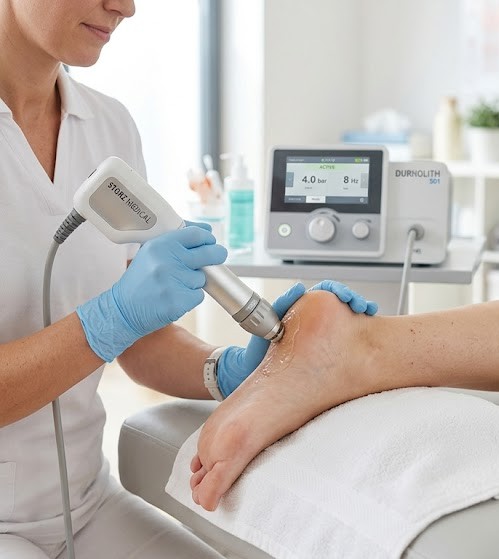
Plantar fasciitis is pain from the plantar fascia, the thick band of tissue running along the sole of the foot from your heel to your toes. It's typically worst with the first few steps in the morning or after sitting for a while, and often eases slightly once you're moving, only to flare again after standing or walking for long periods.
It's usually linked to load the fascia isn't coping with, whether that's a sudden increase in walking or running, prolonged standing, tight calf muscles, or footwear with poor support.
Extracorporeal shockwave therapy (ESWT) delivers focused acoustic pulses through the skin into the affected tissue using a handheld probe. The working theory is that this controlled micro-stress stimulates blood flow and triggers the body's natural healing and tissue-remodelling response in fascia and tendon that hasn't been repairing itself well on its own.
It's a well-established treatment for stubborn, longer-standing plantar fasciitis, typically once symptoms have been present for several months and haven't settled with stretching, load management, and footwear or insole changes.
NICE has reviewed shockwave therapy for refractory plantar fasciitis and concluded that current evidence on its efficacy is adequate to support its use, provided normal arrangements are in place for clinical governance, consent, and audit (NICE Interventional Procedures Guidance IPG311).
It isn't a guaranteed fix for everyone, and results build gradually over several weeks rather than appearing immediately, but for cases that have plateaued on conservative treatment alone, it's a reasonable next step before considering more invasive options.
Clinics use one of two types of machine. Radial units send a pressure wave outward from the applicator head across a wider, shallower area, and are the mainstream choice for the plantar fascia because the target sits close to the surface. Focused units concentrate higher energy at a set depth, cost a clinic considerably more, and are more often found in sports medicine and orthopaedic settings. A 2026 systematic review and meta-analysis in Scientific Reports, pooling nine randomised trials and 530 patients with limb tendinopathy, found no clear superiority of either radial or focused shockwave for pain outcomes, with the certainty of that evidence rated low, so the machine type is a weaker guide to a clinic's quality than its assessment and rehab are.
The strength of the treatment shows up best against the alternatives. A 2024 systematic review and meta-analysis in Clinical Rehabilitation, covering 16 randomised trials and 1,121 patients, found shockwave outperformed corticosteroid injection for pain, fascia thickness and foot function at three months, with the difference in pain and function still present at six. Local soreness and mild redness were the commonest side effects.
Handheld devices sold online as home "shockwave" machines, typically £40 to £200, are a separate product. They are usually percussive massage units, and the trials behind this treatment were run on clinic-grade equipment at specified energy levels and pulse counts that a consumer device does not reproduce. One can be a reasonable comfort measure for a tight calf between sessions, in the same category as a TENS machine. For a diagnosed plantar fascia problem, the equipment that changes the outcome is a clinic machine used inside a proper course, and the calf and foot loading programme that runs alongside it.
A shockwave session takes around 20–30 minutes, including a check of your foot and gait beforehand. Most people describe the treatment itself as uncomfortable rather than painful, and it's normal to feel some soreness in the area for a day or so afterwards.
We typically recommend a course of three sessions spaced roughly a week apart, alongside a loading and stretching programme for your calf and plantar fascia, since shockwave works best when it's supporting active rehab rather than replacing it. Between sessions, some patients also find a TENS machine useful for taking the edge off symptoms day to day, though it's a comfort measure alongside the main treatment rather than a substitute for it.
For some people, tightness through the calf and the soft tissue around the arch of the foot is part of what's keeping the fascia overloaded. Where that's the case, we may add clinical massage to a shockwave course to help that tissue move more freely between sessions, rather than treating the heel in isolation.
Shockwave isn't suitable for everyone. We wouldn't normally use it during pregnancy, over an area with a suspected fracture, tumour, or infection, if you have a bleeding or clotting disorder or are on strong blood-thinning medication, or if you've had a steroid injection in the treatment area within the last four to six weeks. We'll screen for these during your assessment before starting any course.
Shockwave at PhysioHub is £60 for a 30-minute session, £165 for a block of three and £330 for a block of six. Three sessions is the usual starting point for heel pain, so most people are looking at £165 for the shockwave itself. How the treatment works, and which other conditions it suits, is covered in our guide to shockwave therapy in East Sussex.
Before any of that there is the £65 initial assessment, up to 60 minutes, which is where we work out whether your heel pain is actually plantar fasciopathy, whether shockwave is the right call, and what your loading programme needs to look like. Booking a course without that step is how people end up paying for treatment aimed at the wrong problem. Follow-ups to progress the rehab are £55. Every current figure sits on the pricing page, and treatment can be claimed through AXA Health, Aviva, VitalityHealth and WPA, subject to your level of cover.
For context on what that buys locally, published prices for a course of three across East and Mid Sussex ran from £125 to £270 in August 2026. Our sister site has the full comparison in its town-by-town guide to shockwave therapy in East Sussex. When you compare, look at the course total and check whether an assessment and a rehab programme are included in it.
The clinic is in the treatment room at Anytime Fitness Uckfield, Suite 4 on Bell Lane, TN22 5DQ. Most of the heel pain we treat with shockwave comes from Uckfield itself and the villages around it, Buxted, Framfield, Fletching, Halland, Little Horsted, Ringles Cross and Fairwarp, all of which are inside ten minutes by car. Crowborough, Heathfield and Lewes are roughly twenty minutes on the A26 and A272, and people do travel in from all three, partly because none of those towns has a shockwave provider of its own.
Worth thinking about before you commit to a course: three to six visits spaced about a week apart means the journey has to work repeatedly, not just once. Appointments run Monday to Friday from 17.00 to 19.00 and Saturday from 8.00 to 17.00, which is what makes a weekly trip in from Crowborough or Lewes realistic around a job. Home visits can be arranged where travelling in is genuinely not possible. A course stretched out by missed sessions does not do what it should, so it is worth picking a slot you can hold on to for six weeks.
Getting stubborn heel pain dealt with around here tends to mean one of three routes: wait on the NHS musculoskeletal pathway, buy another set of insoles, or pay for something promising to fix it in a single visit. Alex, a HCPC-registered physiotherapist, mostly sees the people those routes have not worked for, often after a year of bracing for the first steps of the morning.
Shockwave is worth being precise about. The evidence supports it for plantar fasciopathy that has not settled with conservative care, and it works by provoking a healing response in tissue that has stopped repairing itself. It is not a substitute for loading. Given alone it tends to help for a while and then fade; given alongside a progressive calf and foot strengthening programme it is what moves most long-standing cases that have been stuck for months. Candidacy matters as well, and someone whose loading has never been addressed usually needs that fixed first.
Our shockwave therapy service starts with the assessment that decides whether you are a suitable candidate, then runs as single sessions or a discounted course.
Shockwave therapy is a well-evidenced option for plantar fasciitis that hasn't responded to the basics, but it works best as part of a plan that also addresses load, footwear, and calf and foot flexibility, not as a stand-alone fix. If your heel pain has stopped responding to rest and stretching, an assessment is the best place to start.
PhysioHub – Empowerment through Evidence-Based Education.
Every body is different. Book a thorough assessment and get advice that is specific to you and your goals.
Book an Appointment