
The five ab exercises worth building a routine around are the front plank, the side plank, the dead bug, the bird dog and the partial curl-up. The first four train the trunk to resist movement, which is what it does all day, and the fifth trains the rectus abdominis through movement at the best ratio of muscle work to spinal load. Current back pain changes the order: start with the dead bug.
Trunk work sits inside a bigger picture when pain travels between regions, which is the subject of PhysioHub's article on head, neck and back pain together.
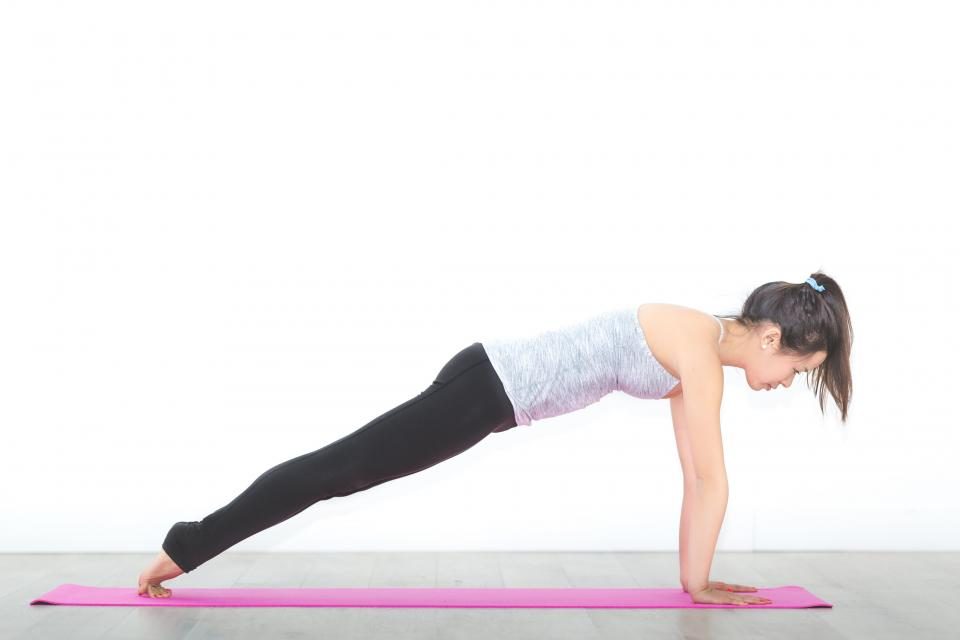
All five need a floor and nothing else. They are ranked on how much trunk work they produce for the load they place on the spine, and on how many people can do them safely.
| Exercise | Best for | What makes it stand out | Dose |
|---|---|---|---|
| 1. Front plank | Whole abdominal wall, anti-extension | Trains the trunk's actual job of holding a line under load | 3 × 20–45 seconds |
| 2. Side plank | Obliques and lateral hip | The highest oblique demand available without equipment | 3 × 15–40 seconds each side |
| 3. Dead bug | Control with the back supported | The one most people with back pain can start on today | 3 × 6–10 each side |
| 4. Bird dog | Trunk plus back extensors | Trains the front and the back of the trunk together | 3 × 6–10 each side |
| 5. Partial curl-up | Rectus abdominis through range | Best muscle challenge per unit of spinal compression in the classic testing | 3 × 10–20 |
This is a documentary review of published biomechanics and clinical evidence rather than a laboratory test run by us. About 15 commonly recommended abdominal exercises were considered, including sit-ups, bicycle crunches, hanging leg raises, ab wheel roll-outs, Swiss ball pikes, hollow holds, Russian twists and the five ranked here.
Four criteria decided the order: how much abdominal muscle activity the exercise produces relative to the compressive load it puts through the lumbar spine, how many people can perform it safely including those with current back pain, whether it needs equipment, and whether it can be progressed for months.
The sources read were Axler and McGill's 1997 study of low back loads across 12 abdominal exercises in Medicine and Science in Sports and Exercise, Escamilla and colleagues' 2010 EMG study in the Journal of Orthopaedic and Sports Physical Therapy, their 2016 study of supine, prone and side positions in Sports Health, a 2011 trial of abdominal exercise and abdominal fat in the Journal of Strength and Conditioning Research, and the 2016 Cochrane review of motor control exercise for chronic low back pain. Evidence checked in August 2026.
What could not be checked: EMG activation and spinal load are laboratory measures, and no trial has ranked these five against each other for the outcomes people care about, such as how a stomach looks or whether a back stops hurting. Treat the ranking as an informed clinical judgement.
Ask what the muscles are for. The abdominal wall mostly resists movement: it stops the lower back arching when you carry a bag, stops the trunk collapsing sideways on one leg, and stops rotation when you push a door. Exercises that ask the trunk to hold still while the limbs move train that job directly.
Weigh the spine load against the muscle work. This is the measurement Axler and McGill built their 1997 study around, dividing peak abdominal activity by peak spinal compression to get a challenge-to-cost ratio. Exercises with a poor ratio are still exercises; they are simply a worse deal when a back is sensitive.
Cover flexion and anti-movement. The same study concluded that no single exercise trained all the abdominal muscles while keeping joint loads low, and that a variety of exercises is therefore required. A routine of nothing but planks leaves the rectus abdominis undertrained through range.
Match it to your back today. The dead bug and bird dog keep the spine in a supported neutral position, which is why they are the usual entry point when back pain is present, and the plank family follows once those are comfortable.
What it is
A held position on the forearms and toes, with the body in a straight line from head to heels and the abdominal wall preventing the lower back from sagging.
Who it suits
Almost everyone, including most people with a settled history of back pain. The kneeling and hands-on-a-worktop versions bring it within reach of anyone.
How to do it
Elbows under the shoulders, forearms flat, feet hip width. Squeeze the glutes and tuck the pelvis very slightly so the lower back flattens out of its arch. Breathe normally throughout. Three sets of 20 to 45 seconds, stopping the set when the hips start to drop rather than when the timer says so.
What the evidence supports
Prone positions produce the highest rectus abdominis activity of the common floor positions. Escamilla and colleagues' 2016 study in Sports Health compared supine, prone and side exercises and found the prone group generated greater rectus abdominis activity than the side group, with the prone bridge among the highest for internal oblique activity. The plank also produces this while the spine stays neutral, which keeps the compressive cost modest.
Limits and cautions
Holding the breath and letting the hips sag are the two faults that turn a good plank into a lower back exercise. Wrist or shoulder pain is usually solved by dropping to the forearms or elevating the hands. Beyond about two minutes the exercise stops adding strength, so change the leverage instead of the clock.
Time and effort
Under three minutes for three sets. It needs no warm-up and no recovery.
Why it made the list
It ranks first on breadth. It trains the whole abdominal wall in the role it plays in daily life, it can be regressed to a kneeling hold or progressed to a single-leg long-lever hold, and very few people are unable to do a version of it.
What it is
A held position on one forearm and the side of the feet, with the hips lifted so the body forms a straight line from head to ankles.
Who it suits
Runners, anyone with a hip that drops on one side, and anyone whose routine is already plank-heavy and needs the sideways demand.
How to do it
Elbow under the shoulder, knees bent to start with, hips pushed up and forward until the body is in line. Hold 15 to 40 seconds each side, three sets. Progress by straightening the legs, then by lifting the top leg. The knees-bent version is a genuine exercise rather than a warm-up.
What the evidence supports
The side plank is the standard way to load the obliques and the lateral hip together without loading the spine in flexion. In the 2016 Escamilla comparison, side-position exercises produced the greatest lumbar paraspinal recruitment of all the positions tested, so this is a trunk exercise in the fullest sense rather than an abdominal one alone.
Limits and cautions
Shoulder pain in the supporting arm is common and usually means the elbow has drifted out from under the shoulder. People with a painful hip on the down side often prefer the knees-bent version indefinitely, which is fine.
Time and effort
Four minutes for both sides. Compare the two sides every week; a difference of more than about a third is worth acting on.
Why it made the list
It covers the plane of movement everything else on this list misses, and it doubles as a hip exercise, which is why it appears in almost every low back and running programme. Our hip exercise sheet uses the same principle from the other direction.
What it is
Lying on your back with the knees and hips bent to 90 degrees and the arms up, then lowering one arm and the opposite leg towards the floor while the lower back stays flat.
Who it suits
Anyone with current or recent low back pain, anyone who is pregnant or postnatal and has been cleared for exercise, and anyone who finds planks aggravate their neck or shoulders.
How to do it
Press the lower back gently into the floor and keep it there. Lower the opposite arm and leg slowly, stopping the moment the back begins to arch, then return. Six to ten controlled repetitions each side, three sets. The range you can hold the back flat through is the range you train in.
What the evidence supports
The dead bug is a standard motor control exercise, and motor control exercise has the best-studied evidence base of any trunk approach for back pain. The 2016 Cochrane review by Saragiotto and colleagues, covering 29 trials and 2,431 participants, found motor control exercise produced medium-sized improvements in pain and disability compared with minimal intervention, and results similar to other forms of exercise and to manual therapy.
Limits and cautions
The common fault is speed. Done fast, the back arches and the exercise turns into a hip flexor exercise. If the back lifts off the floor at all, shorten the range until it does not.
Time and effort
Four minutes. It is the exercise most likely to look easy and feel hard when done properly.
Why it made the list
It is the entry point that works when the others do not. Someone whose back is sore this week can do it today and progress from it, which is worth more than a harder exercise that gets skipped.
What it is
On hands and knees, extending one arm forward and the opposite leg back while the trunk resists rotating or arching.
Who it suits
Anyone who wants the back extensors trained alongside the abdominals, and anyone whose work involves long periods bent forward.
How to do it
Hands under shoulders, knees under hips, spine level. Reach one arm forward and the opposite leg back to roughly hip height, hold for two or three seconds, and return under control. Six to ten each side, three sets. A glass of water balanced on the lower back is the traditional test of whether the hips are staying level.
What the evidence supports
The bird dog is the third of the three exercises that came out of Stuart McGill's laboratory work on training the trunk at low spinal cost, alongside the curl-up and the side bridge. It produces moderate abdominal activity with high back extensor activity at a compressive load most sensitive backs tolerate, which is why it appears in so many rehabilitation programmes.
Limits and cautions
Wrist pain on all fours is common; a fist position or forearms on a low bench solves it. Lifting the leg above hip height arches the lower back and undoes the point of the exercise.
Time and effort
Four minutes. Fatigue shows up as wobble rather than burn, so watch the quality rather than the count.
Why it made the list
It is the only exercise here that trains the back of the trunk properly, and a trunk trained only from the front is half done. It pairs naturally with the desk-related work in our neck strengthening guide.
What it is
A short-range curl in which the head and shoulder blades lift a few centimetres off the floor while the lower back stays in contact with it.
Who it suits
Anyone with a healthy back who wants the rectus abdominis trained through movement, and anyone whose sport involves trunk flexion.
How to do it
Lie on your back with one knee bent and one leg straight, hands under the small of the back to keep it in its natural position. Lift the head and shoulder blades a short way, pause, and lower slowly. Ten to 20 repetitions, three sets. The movement is small on purpose.
What the evidence supports
Axler and McGill's 1997 study in Medicine and Science in Sports and Exercise tested 12 abdominal exercises in nine volunteers and calculated a muscle challenge-to-spine cost index by dividing peak abdominal EMG by peak lumbar compression. The partial curl-ups produced the highest indices of everything tested. The same paper concluded that no single exercise trained all the abdominal muscles at a low joint load, which is the argument for using several.
Limits and cautions
Repeated end-range flexion under load is the pattern that aggravates some disc-related back pain, so anyone in a current episode should stay with the first four exercises. Hands behind the head pulling the neck forward is the usual technical fault, and it produces neck ache within a week.
Time and effort
Three minutes. It is the only exercise here where the reps come easily, which is exactly why the range has to stay short.
Why it made the list
It is the flexion exercise with the best evidence for muscle work per unit of spinal load, and it fills the gap the four anti-movement exercises leave.
| Exercise | Main target | Spine position | Usable with current back pain | Main progression | Equipment |
|---|---|---|---|---|---|
| Front plank | Rectus abdominis, obliques | Neutral, held | Usually, once settled | Long lever, single leg | None |
| Side plank | Obliques, lateral hip, paraspinals | Neutral, held sideways | Usually, knees bent first | Straight legs, top leg lift | None |
| Dead bug | Deep abdominals, control | Neutral, back supported | Yes, this is the starting point | Longer lever, slower tempo | None |
| Bird dog | Abdominals and back extensors | Neutral, on all fours | Yes | Add a hold, then a slow crawl | None |
| Partial curl-up | Rectus abdominis | Small range of flexion | Not during a flare-up | Slower tempo, arms crossed higher | None |
The one column that changes people's programmes is the fourth. Four of these five can be started during a back pain episode, which is the opposite of what most ab routines assume.
If your back is sore right now, start with the dead bug and the bird dog, twice a day if you like, and add the plank family once you can do both without symptoms.
If you want visible abdominal definition, train these for strength and treat body composition as a separate project. Six weeks of daily abdominal work with no change in diet produced no measurable change in abdominal fat in the trial cited below.
If you run or play sport, prioritise the side plank and the bird dog, which train the sideways and rotational control that shows up in single-leg activity. Add the whole-body work in our guide to the best exercises without equipment around them.
If you sit at a desk all day, the bird dog and side plank do more for you than any amount of curling, because the muscles that fatigue are the ones holding you upright. Middle and upper back pain covers the rest of that picture.
If you have 8 minutes, twice a week, do the plank, the side plank and the dead bug. That covers the three planes and needs no equipment or floor space beyond a mat.
A sore back is a reason to change the trunk work, and keeping some of it going usually helps the back settle. The five exercises here behave differently during a flare.
Usually tolerated: the dead bug and the bird dog, which load the spine very lightly, and the side plank from the knees. Keep short: the front plank, in holds of 10 to 20 seconds with good breathing, stopping before the lower back starts to sag. Hold back for now: the partial curl-up, and any hold that ends in shaking, until a normal day passes without the back reminding you of it. Then bring them back one at a time. NICE guideline NG59 recommends exercise programmes as a core treatment for low back pain and names no single best type, which is why choosing exercises the back tolerates matters more than choosing the perfect one.
In the first fortnight of a new episode, our exercises for the first two weeks of back pain are the gentler place to start, and our guide to lower back exercises in the gym covers the heavier work that follows. Numbness around the groin, new bladder or bowel changes or weakness in a leg need urgent medical assessment.
Do ab exercises burn belly fat?
No. A 2011 trial in the Journal of Strength and Conditioning Research had 24 sedentary adults perform seven abdominal exercises five days a week for six weeks on a controlled diet, and found no change in body weight, body fat percentage, abdominal circumference or abdominal skinfold measurements. Abdominal endurance improved substantially. Fat loss comes from a calorie deficit across the whole body, and the abdominal muscles then become visible underneath.
Are planks better than crunches?
They train different jobs, so a good routine has both. The plank trains the abdominal wall to resist movement while the spine stays neutral, which is what the trunk does when you carry, push and walk. The partial curl-up trains the rectus abdominis through movement and produced the highest ratio of muscle challenge to spinal compression of the 12 exercises Axler and McGill tested in 1997.
How often should you train your abs?
Two or three sessions a week of 8 to 10 minutes is enough for most people, which fits inside the NHS advice to do strengthening activity covering all the major muscle groups on at least 2 days a week. The abdominal muscles recover quickly, so daily short sessions are safe, though they add little over three well-progressed sessions.
How long should you hold a plank?
Aim for three sets of 20 to 45 seconds with good position. Once you can hold two minutes, the exercise has become an endurance test, so change the leverage instead: lift one foot, reach one arm forward, or move the elbows further ahead of the shoulders.
Are sit-ups bad for your back?
Full sit-ups place a high compressive load on the lumbar spine for the abdominal work they produce, which is why the partial curl-up is preferred in rehabilitation. For a healthy back, a moderate number of sit-ups is fine. For someone with current low back pain or a known disc problem, the partial curl-up and the anti-movement exercises on this page are the better starting point.
Will core exercises fix my back pain?
They help, to about the same degree as other forms of exercise. The 2016 Cochrane review of 29 trials and 2,431 participants found motor control exercise clearly better than minimal intervention for chronic low back pain, and similar to other types of exercise. The practical reading is that the exercise you will actually keep doing is the one to choose.
Which ab exercise activates the muscles most?
In a 2010 JOSPT study by Escamilla and colleagues, the ab wheel roll-out and the Swiss ball pike produced the highest activation of the upper rectus abdominis (63% and 46% of maximum voluntary contraction) while keeping back extensor activity low, and the pike reached 84% for the external obliques. Both need equipment, which is why neither is ranked here, and both are demanding enough that they suit an already-strong trunk.
PhysioHub – Empowerment through Evidence-Based Education.
Trunk strength is one of the better supported tools for a recurring sore back, and our guide to back pain covers where it fits alongside everything else that settles it.