
Six home exercises cover almost everything a painful or weak knee needs: step-ups, wall squats, glute bridges, side-lying hip work, straight leg raises and calf raises. Do them three times a week, two to three sets of 10 to 15, keeping pain at or below 3 out of 10. Where the knee is very sore, start at number five and work upwards.
Where the pain sharpens specifically on the way downstairs, the reason that direction loads the kneecap hardest is set out in PhysioHub’s guide to knee pain going down stairs.
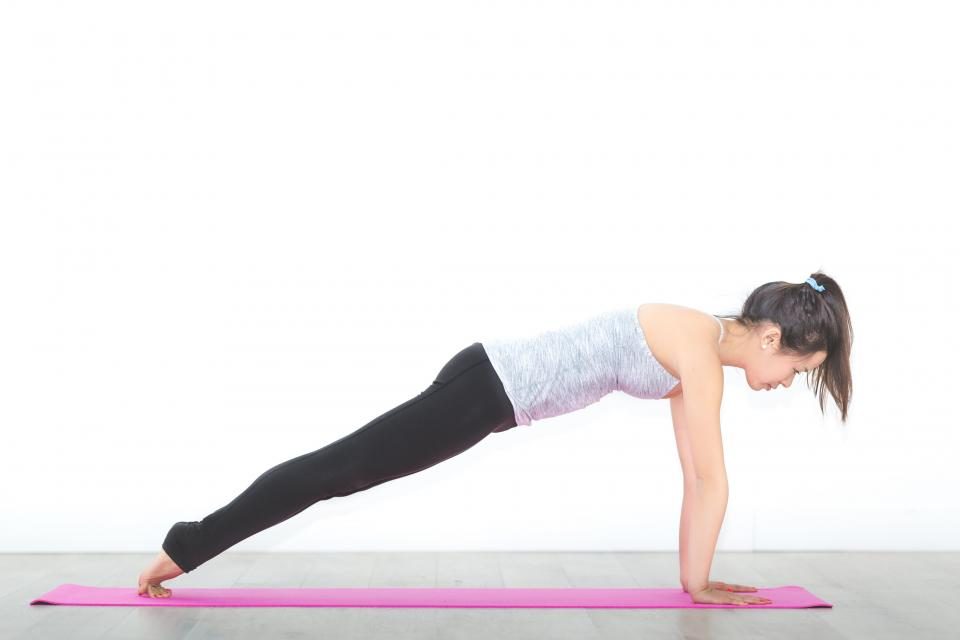
These six are ranked on how much usable knee strength each one builds, weighed against how many people can perform it while the knee is sore. If your knee is painful today, start at number five and climb the list as symptoms allow.
| Exercise | Best for | Starting dose | Knee load |
|---|---|---|---|
| 1. Step-up on a low step | Stairs, hills and getting out of a chair | 2–3 × 10 each leg on a 10cm step | Moderate, functional |
| 2. Wall squat | Quadriceps strength under control | 3 × 20–30 second holds at 45° | Moderate, adjustable by depth |
| 3. Glute bridge | Hip and hamstring support for the knee | 3 × 12 with a 2 second squeeze | Minimal |
| 4. Side-lying hip abduction and clamshell | Kneecap tracking and hip control | 3 × 12–15 each side | None |
| 5. Straight leg raise | The entry point for a very sore knee | 3 × 10 with a 3 second hold | None, the knee stays straight |
| 6. Standing calf raise | Shock absorption below the knee | 3 × 15, lowering slowly | Low |
Three sessions a week covering all six takes about 25 minutes. Two sessions covering the top four still produces most of the benefit.
This is a documentary review of published clinical evidence and guidance rather than a programme prescribed for your knee. Around twenty exercises commonly given for knee pain were considered, including the six here plus terminal knee extensions, seated knee extensions, sit-to-stands, split squats, leg press, hamstring curls, Nordic curls, step-downs, single-leg balance work, wall slides and stationary cycling.
Three criteria decided the ranking: how much strength the exercise builds in the muscles that control the knee, how far it can be progressed at home over several months, and how many people can perform it while the knee is still painful.
The sources read were the 2024 Cochrane review of exercise for knee osteoarthritis by Lawford and colleagues, covering 139 trials and 12,468 participants, NICE guideline NG226 on osteoarthritis, and the 2018 JOSPT meta-analysis by Nascimento and colleagues on hip and knee strengthening for patellofemoral pain. Evidence checked in August 2026.
What could not be checked: no trial has ranked these six against each other, and the effect of exercise on knee pain in the Cochrane review is real but modest, at about 8.7 points on a 100 point scale. Knee pain also has causes that exercise does not address, so a knee that locks, gives way, swells within hours of an injury or is hot and painful with a fever needs assessing rather than training around.
Load the hip as well as the knee. The strongest single finding in this area is that hip and knee strengthening together beats knee strengthening alone for kneecap pain. Two of the six exercises here work the hip, and skipping them is the most common way a home programme underdelivers.
Pick the entry point from how the knee is today. A knee that hurts sitting still can usually manage straight leg raises, glute bridges and clamshells. That is already three exercises and a real session, and it keeps the habit going while symptoms settle.
Progress by one variable at a time. Add reps, then add range or height, then add weight. Changing two at once makes a flare-up impossible to interpret, and interpreting flare-ups is how you learn what your knee tolerates.
Judge it the next morning. Muscle soreness across the thigh that eases within a day or two is training working. A knee that is stiffer, warmer or more swollen the following morning was loaded too hard, and the fix is a fifth less volume rather than stopping.
What it is
Stepping up onto a low box or the bottom stair with one leg, standing tall, then lowering under control.
Who it suits
Anyone whose knee complains on stairs, hills or getting out of a chair, which covers most people with knee pain.
How to do it
Start with a 10cm step, about the height of one stair. Place the whole foot on the step, drive up through that heel without pushing off the back foot, stand fully upright, then lower slowly over three seconds. Two to three sets of 10 on each leg. Progress by raising the step to 15 or 20cm, then by holding a light dumbbell in each hand.
What the evidence supports
Step-ups train the quadriceps and the gluteal muscles together through the exact range used on stairs, which is where knee pain most often shows itself. Exercise programmes of this kind are the core treatment NICE recommends for osteoarthritis, alongside weight management where that applies, and the Cochrane review found they improve physical function by around 11 points on a 100 point scale.
Limits and cautions
Pushing off the trailing foot is the fault that quietly removes most of the training effect. Filming one set from the side settles it. Where the knee dips inwards as you rise, drop the step height until it stays over the middle toes.
Time and effort
Five minutes, and the equipment is a staircase.
Why it made the list
It ranks first because it builds strength in the pattern that knee pain actually interferes with, and because it scales from a doorstep to a loaded box over months.
What it is
Leaning back against a wall with the feet forward, sliding down to a bent-knee position and holding it.
Who it suits
Anyone who needs quadriceps strength but finds free squatting painful, and anyone in the early weeks of a kneecap pain problem.
How to do it
Stand with your back flat to a wall and your feet about half a metre forward. Slide down until the knees are bent to roughly 45 degrees and hold for 20 to 30 seconds. Three holds. Progress by sliding deeper towards 60 and then 90 degrees, then by taking most of the weight through one leg. A gym ball behind the back makes the slide smoother where the wall catches your clothing.
What the evidence supports
Holding a position under tension loads the quadriceps hard with no movement at the kneecap, which is why it is tolerated when moving squats are not. Quadriceps weakness is one of the most consistent findings in both knee osteoarthritis and kneecap pain, and building it back is a component of nearly every trial in the Cochrane review.
Limits and cautions
Depth is the dial that matters. A shallow hold that you can keep for 30 seconds is more useful than a deep one you abandon at eight. Anyone who feels a sharp pinch at the front of the knee has gone too deep for now.
Time and effort
Four minutes, and it needs a wall.
Why it made the list
Nothing else here loads the quadriceps this hard with this little demand on technique, and the depth setting means almost every knee can find a version of it.
What it is
Lying on your back with the knees bent and feet flat, lifting the hips until the body forms a straight line from shoulder to knee.
Who it suits
Everyone in this programme, including people whose knee is too painful for weight-bearing exercise this week.
How to do it
Feet hip-width apart and about a hand’s length from your bottom. Push through the heels, lift the hips and squeeze the muscles at the back of the hip for two seconds at the top, then lower slowly. Three sets of 12. Progress by extending one leg and bridging on the other, which roughly doubles the demand.
What the evidence supports
The gluteal muscles control how the thigh bone rotates and drops inward during walking and stairs, and that position determines how the kneecap sits in its groove. This is the mechanism behind the finding that adding hip strengthening to knee strengthening produces better results for kneecap pain than knee work alone.
Limits and cautions
Arching the lower back to lift higher is the usual fault and turns the exercise into a back extension. Stop where the body is straight. Cramping in the hamstrings means the feet are too far away, so bring them closer.
Time and effort
Four minutes, on the floor, with nothing else needed.
Why it made the list
It trains the hip half of the equation with essentially zero load through the knee joint, which makes it available in almost every week of a rehabilitation programme.
What it is
Two side-lying exercises for the muscles on the outside of the hip: lifting the top leg straight up, and lifting the top knee while the feet stay together.
Who it suits
Anyone with pain around or behind the kneecap, anyone whose knee visibly drops inwards on a single-leg squat, and anyone who cannot tolerate weight through the knee at all.
How to do it
For the abduction, lie on your side with the body in a straight line and lift the top leg about 30cm, leading with the heel rather than the toes, then lower slowly. For the clamshell, bend both knees to about 45 degrees, keep the heels together and rotate the top knee open without letting the pelvis roll backwards. Three sets of 12 to 15 each side. Progress by adding a looped resistance band above the knees.
What the evidence supports
This is the hip work behind the Nascimento meta-analysis, which pooled 14 trials and 673 people with patellofemoral pain and found combined hip and knee strengthening better than knee strengthening alone for both pain and activity, with the benefit maintained after the programme ended.
Limits and cautions
Rolling the pelvis backwards to get more height converts a hip exercise into a trunk one, and it is the reason many people feel nothing in the target muscle. A wall behind your back gives you something to check against. Anyone with pain on the bony point of the hip should keep the range small at first.
Time and effort
Six minutes for both, on the floor.
Why it made the list
It has the best-evidenced case of anything here for kneecap pain specifically, and it puts no compressive load through the knee at all. Our full hip exercise sheet covers the progressions beyond these two.
What it is
Lying on your back and lifting the whole straight leg about 30cm off the floor while the other knee stays bent.
Who it suits
A knee that is too painful or too swollen for anything weight-bearing, and the first week after many knee operations.
How to do it
Tighten the thigh muscle first so the knee is locked straight, then lift the leg to about 30cm, hold for three seconds and lower slowly. Three sets of 10. Progress by adding a 1 to 2kg ankle weight once 10 reps feel easy.
What the evidence supports
The knee does not move, so the exercise loads the quadriceps with no joint compression and no shearing at the kneecap. That is what makes it the standard starting point after knee surgery and during an acute flare-up, when the aim is to hold onto thigh muscle rather than build it.
Limits and cautions
The knee sagging into a slight bend as the leg rises removes most of the point. Lifting higher than about 30cm adds nothing and shifts the work to the hip flexors, which is where people with a sensitive lower back tend to feel it.
Time and effort
Four minutes, on the floor or in bed.
Why it made the list
It ranks fifth on strength built and first on availability. It is the exercise that keeps a programme alive during the weeks when the others are too much.
What it is
Rising onto the balls of the feet from standing, then lowering slowly.
Who it suits
Anyone returning to walking, hills or running, and anyone whose knee pain came on after a period of inactivity.
How to do it
Stand with fingertips on a wall for balance, rise as high as you can onto the balls of both feet, then lower over three seconds. Three sets of 15. Progress to one leg at a time, then to standing on the edge of a step so the heel can drop below the level of the toes.
What the evidence supports
The calf absorbs a large share of the force at each step before it reaches the knee, and calf strength drops quickly during any period of reduced walking. Restoring it is a routine part of lower limb rehabilitation, though the direct evidence for calf work reducing knee pain specifically is thinner than for the quadriceps and hip exercises above.
Limits and cautions
Bouncing through the movement uses tendon recoil rather than muscle, so the slow lowering is where the value is. Anyone with a history of Achilles pain should build up the single-leg version gradually.
Time and effort
Three minutes, standing anywhere.
Why it made the list
It ranks last because its case rests on general lower limb reasoning more than on knee-specific trial evidence. It stays on the list because it is quick, it is available to almost everyone, and the calf is the most commonly neglected muscle in a knee programme.
| Exercise | Main target | Weight through the knee | Usable in a flare-up | Equipment | Room to progress |
|---|---|---|---|---|---|
| Step-up on a low step | Quadriceps and glutes | Yes, full bodyweight | Once improving | A stair or box | Very high |
| Wall squat | Quadriceps | Yes, adjustable by depth | Often, at a shallow angle | A wall | High |
| Glute bridge | Glutes and hamstrings | No | Yes | None | Moderate |
| Hip abduction and clamshell | Gluteus medius | No | Yes | None, band later | Moderate |
| Straight leg raise | Quadriceps | No | Yes, this is the starting point | None, ankle weight later | Low |
| Standing calf raise | Calf | Low | Usually | None, step later | High |
The fourth column is the one that decides most programmes. Four of the six stay available during a bad week, which is why a knee flare-up rarely justifies stopping altogether.
If your knee hurts sitting still or is visibly swollen, do straight leg raises, glute bridges and clamshells only, three times a week, and add the wall squat once the swelling settles.
If stairs are the problem, prioritise step-ups and wall squats, and add the hip work, because stair pain is the classic presentation of the kneecap tracking problem the hip exercises address.
If you have been told you have osteoarthritis, run all six. Exercise and weight management where it applies are the core treatments NICE recommends, and the joint tolerates loading better than most people expect. Where weight is part of the picture, see exercise and strength work for weight loss when your joints hurt.
If you are building back towards running, add the single-leg progressions of the bridge and the calf raise early, and read our guide to knee pain when running before increasing mileage.
If you have 15 minutes, twice a week, do step-ups, wall squats and clamshells. That covers the quadriceps, the functional pattern and the hip.
If the knee locks, gives way, or swelled up within a couple of hours of an injury, get it assessed before starting a programme. Those are mechanical signs that exercise does not resolve.
How often should you do knee strengthening exercises at home?
Three times a week on non-consecutive days, with a fourth session added once the first three feel comfortable. Muscle and tendon need roughly 24 to 48 hours between loading sessions to adapt. Where the knee feels stiff or warm the following morning, cut the volume by about a fifth before trying to progress again.
Should I push through knee pain while exercising?
Pain up to about 3 out of 10 that settles within 24 hours is acceptable and expected. NICE guidance on osteoarthritis tells clinicians to warn people that joint pain often increases when therapeutic exercise starts, and that continuing anyway is what produces the benefit. Sharp pain above 4 out of 10, new swelling, or an ache that is worse the next morning means reducing the range or dropping back to isometric holds.
Why do hip exercises help knee pain?
The gluteal muscles control how far the thigh bone rotates inward and drops across the midline, which changes how the kneecap sits in its groove. A 2018 meta-analysis of 14 trials and 673 people with patellofemoral pain found that strengthening the hip and the knee together reduced pain and improved activity more than strengthening the knee alone, and the benefit was still there after the programme finished.
How long before knee strengthening exercises work?
Most people notice a change in six to eight weeks, and strength gains continue for months after that. The first two weeks often feel worse rather than better as the joint adapts to being loaded again. Judging the programme before six weeks is the most common reason people abandon one that was working.
Can you strengthen your knees without weights?
Yes. Five of the six exercises here need nothing but a wall, a floor and a step, and bodyweight is enough to build meaningful strength in a deconditioned leg. Weight becomes useful once you can complete three sets of 15 comfortably, at which point adding a dumbbell or an ankle weight is what keeps the programme progressing.
Are squats bad for your knees?
No, for most people. A controlled squat loads the knee in the pattern it uses every time you sit down or climb stairs, and building tolerance to that load is the point of the exercise. Depth is what needs managing: a wall squat at 45 degrees puts far less pressure through the kneecap than a deep squat, which is why the programme starts shallow and increases depth as symptoms allow.
Which knee exercises should I avoid with arthritis?
Very few are off the list permanently. Deep loaded squatting, long periods of kneeling and high-impact jumping are the ones most likely to flare an arthritic knee in the early weeks. Everything in this programme is designed to be tolerable with osteoarthritis, and the Cochrane evidence supporting exercise for knee osteoarthritis comes from programmes built on exactly these movements.
PhysioHub – Empowerment through Evidence-Based Education.
Strength work is the mainstay for most knee pain, from kneecap pain to wear and tear, and our guide to knee pain covers which problem needs which emphasis.