
Shockwave therapy comes up most often for the kind of tendon or heel pain that has dragged on for months and shrugged off rest, stretching and painkillers. It sounds more dramatic than it is, and the name puts people off, so this is a plain guide to what it actually is, how it works, and whether it is likely to help.
Where the problem is stubborn heel pain specifically, the same treatment and the evidence behind it are set out in more depth in PhysioHub's guide to shockwave therapy for plantar fasciitis.
The sections below work through it in order, from the definition to who should not have it, so you can read the whole thing or open the part you came for.
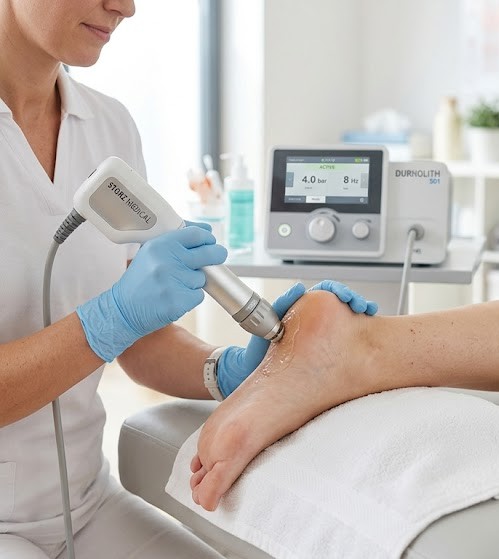
Shockwave therapy is a non-invasive treatment that delivers high-energy acoustic waves, mechanical sound waves, into injured tissue through the skin. In a physiotherapy clinic its full name is extracorporeal shockwave therapy, usually shortened to ESWT and sometimes written ECSWT; the radial form is occasionally labelled RSWT. "Extracorporeal" simply means the energy is generated outside the body and passed inward, so nothing is injected and nothing is cut.
Despite the name, it has nothing to do with an electric shock. A TENS machine and other electrical treatments pass a small current through the skin to alter pain signals, and they work in a completely different way. Shockwave delivers a rapid mechanical pressure wave through the tissue instead, closer in principle to the focused sound energy long used to break up kidney stones than to anything electrical.
A handheld applicator is pressed against the skin and fires repeated pressure waves that pass through the surface into the tendon, fascia or muscle underneath. Those waves create a controlled micro-stress in tissue that has stopped healing well on its own, and it is the body's response to that stimulus, rather than the wave itself, that does the work.
Several things are thought to follow. Blood flow to the area increases, bringing in the cells and nutrients that repair depends on. The mechanical stimulus prompts local cells, including the fibroblasts that build tendon, to step up their activity and lay down fresh collagen, the protein that gives a healthy tendon its strength. And it appears to restart a stalled healing and remodelling response, nudging a long-standing, worn tendon back toward repair. Because that tissue turns over slowly, the effect builds over several weeks rather than appearing at once.
Clinics use one of two machine types, and the difference is real even though marketing tends to overstate it.
Radial shockwave sends a pressure wave outward from the applicator head, strongest at the surface and spreading wider and shallower as it travels. It suits soft-tissue targets that sit close to the skin, which is most of the work: the plantar fascia, the Achilles, and tennis and golfer's elbow.
Focused shockwave concentrates higher energy at a set depth, reaching a precise deeper point. The machines cost a clinic considerably more and are more often found in sports medicine and orthopaedic settings.
For the superficial targets that make up most referrals it is a weaker guide to quality than clinics imply. A 2026 systematic review and meta-analysis in Scientific Reports, pooling nine randomised trials and 530 patients with limb tendinopathy, found no clear superiority of either radial or focused shockwave for pain outcomes, with the certainty of that evidence rated low. The clinician who assessed you and built your loading plan matters more than which machine is in the room.
It is used mainly for longer-standing tendon and soft-tissue problems that have not settled with the usual measures:
These share a pattern: chronic pain in a tendon or its attachment, often in someone active, that has plateaued on rest and exercise alone. Shockwave is also used well beyond musculoskeletal medicine, a focused, higher-energy form has broken up kidney stones for decades, and low-intensity versions are used in other fields, but those are different protocols on different machines. The musculoskeletal use is what a physiotherapy clinic offers.
Shockwave is a second-line treatment. It is aimed at chronic problems, typically ones that have been present for several months and have not responded to the first-line measures: relative rest, activity and load management, a change of footwear or insoles, and a progressive exercise programme. For a tendon that has genuinely stalled on good conservative care, it is a reasonable next step before more invasive options such as injections or surgery.
It is not a first move for a fresh injury, and it does not suit every stubborn case. Whether it is right for you depends on the diagnosis and on what has already been tried, which is why an assessment comes first. The people who get the least from a course are usually those whose underlying loading was never addressed, so the tissue meets the same demand again between sessions.
A typical appointment runs about 20 to 30 minutes. The clinician confirms the area to be treated, then applies a layer of contact gel to the skin so the waves transmit efficiently, the same reason gel is used for an ultrasound scan. The handheld probe is placed on the spot and the pulses are delivered in bursts, with the intensity set to a level you can tolerate.
There is no injection, no incision and no anaesthetic, and you go home the same day with no downtime. A course is usually three to six sessions spaced about a week apart, run alongside an exercise programme, because the weekly spacing and the loading in between are part of how the treatment accumulates. Most people carry on with normal daily activity straight away.
Shockwave is generally safe and non-invasive. It can feel uncomfortable, and sometimes briefly painful, for the few minutes the probe is working over the sore area. The intensity can be turned down if it is too much and built back up as you settle, and most people describe the treatment as uncomfortable rather than genuinely painful.
Side effects are usually short-lived: some soreness, mild swelling, redness or occasionally a little bruising over the treated area for a day or two. That mild reaction is part of the healing response the treatment is meant to provoke. Serious problems are rare.
Where it works, the gains people notice are less pain and better function, letting them get back to the walking, standing or sport the problem had limited. The mechanism points to real tissue change alongside symptom relief, improved blood flow, new collagen and a restarted repair response, which is why the benefit tends to hold when shockwave is paired with rehab.
For calcific tendinopathy the theory is that the waves help break down the calcium deposit so the body can reabsorb it, easing the mechanical block and restoring movement. The honest position is that how strong the case is depends on the condition. NICE found the efficacy evidence for shockwave in calcific shoulder tendinopathy inadequate, recommending it only in the context of research (IPG742), whereas for plantar fasciitis it judged the evidence adequate to support its use (IPG311). A 2024 systematic review and meta-analysis in Clinical Rehabilitation, covering 16 randomised trials and 1,121 patients, found shockwave outperformed corticosteroid injection for pain and foot function at three months. It helps some problems well and others less reliably, and a good clinic will tell you which of those yours is.
Shockwave works best as one part of a plan. The single most important pairing is a progressive loading and rehabilitation programme for the affected tendon, because that is what rebuilds the tissue's capacity and stops the problem returning once the course ends. Used on its own, the benefit of shockwave tends to fade.
Depending on the problem, other things help too. Looking at your gait and biomechanics can show why a tendon is being overloaded in the first place, so the load can be eased. Hands-on treatment such as clinical massage can free up the surrounding tissue between sessions. On aftercare, clinics usually advise avoiding anti-inflammatory painkillers around treatment, since the mild inflammation is part of the intended response, and easing off very heavy loading of the treated area for a day or two.
Shockwave is not suitable for everyone, and part of the assessment is screening for the situations where it is avoided or deferred. It is generally not used during pregnancy, over an area with a suspected fracture, tumour or active infection, or for people with a bleeding or clotting disorder or on strong blood-thinning medication. It is also usually deferred if you have had a steroid injection in the treatment area within the last few weeks.
Even when it is suitable, effectiveness varies between individuals, and it is not a guaranteed fix. That is the reason a clinic should be clear with you from the start about what a course can and cannot be expected to do, and should have a plan for what happens if it is not helping by the third session.
Getting seen for a stubborn tendon in East Sussex usually comes down to a few routes. The NHS East Sussex MSK Community Partnership handles musculoskeletal referrals across the area and is worth asking about first, though shockwave sits in NICE's interventional procedures guidance rather than routine commissioning, so whether a service offers it varies and a wait tends to come with it. Privately, a clinic that owns a machine can assess you and begin a course together, usually within days.
What the assessment adds is the part the machine cannot. Not every heel is a plantar fascia problem and not every stubborn tendon has stalled for the same reason, so confirming the diagnosis is what stops a course being aimed at the wrong tissue, and it is where the loading plan that makes the treatment hold gets built. Because shockwave is a second-line option, the assessment is also where you find out whether it is the right next step at all, or whether something simpler has not yet been tried.
For people in and around Uckfield weighing that up, our shockwave therapy service page sets out how a course and the rehab around it run here.
Is shockwave therapy painful? It can be uncomfortable, and briefly sharp, for the few minutes the probe is on the sore area. The intensity is adjustable, and most people tolerate it well and carry on normally afterwards.
How many sessions will I need? Usually three to six, spaced about a week apart, alongside an exercise programme. Improvement builds over several weeks rather than immediately.
Do I need a referral to have it privately? No. Private physiotherapy is self-referral in the UK, though an insurer may ask for a referral before covering a claim.
Is it available on the NHS in East Sussex? It depends on the service. Shockwave sits in NICE's interventional procedures guidance rather than routine commissioning, so availability varies and it is worth asking the local musculoskeletal service.
Does radial or focused shockwave matter for my problem? For the common superficial targets, the trials show no clear advantage either way. The assessment and the rehab plan matter more than the machine type.
PhysioHub – Empowerment through Evidence-Based Education.
Every body is different. Book a thorough assessment and get advice that is specific to you and your goals.
Book an Appointment